

Buying an apartment or other investment property in Ontario is not a terribly complicated endeavour, but there are certain things you should be aware of. A good well-structured offer, along with a strong strategy going into negotiations, will help protect you as well as ensure a smooth and successful acquisition.
Phase 1: The Pre-Offer Strategy
Before putting pen to paper, the most critical step is discovering where the seller’s head is at. I divide this preliminary research into four vital pillars:
- Price and Seller Motivations Price is not necessarily the most important factor to a seller. For instance, if a seller needs to quickly move capital into a much larger, more profitable project, they will likely prioritize a fast closing over getting top dollar. Conversely, a retiring seller may only care about maximizing the final price and will gladly accommodate a two-week or two-year closing.
- Timelines and Tax Implications Understanding the seller's preferred timeline can give you significant negotiating leverage. For example, if a seller is offloading their second or third building of the year, they may face substantial capital gains taxes. By offering to delay the closing date for six to twelve months, you solve their tax issue—which can often be traded for a concession on the purchase price.
- Terms and Conditions A preliminary conversation helps outline your expectations in broad strokes so the seller is not surprised by your formal offer. This is the time to mention that your lender will require a Phase 1 environmental assessment, a building condition report, and roof inspections.
- The Buyer’s Covenant (Trust) In commercial real estate, "covenant" is the industry term for trust. The seller must trust that you can successfully navigate due diligence, secure your financing, and close the deal. A strong buyer covenant can absolutely beat a higher offer. In fact, properties sometimes sell for less money to a buyer with a proven track record, simply because higher bidders failed to secure financing or navigate their due diligence. Coming to the table with your lender and consultants already prepared is highly valuable to a seller.
Phase 2: Structuring the Mandatory Fields
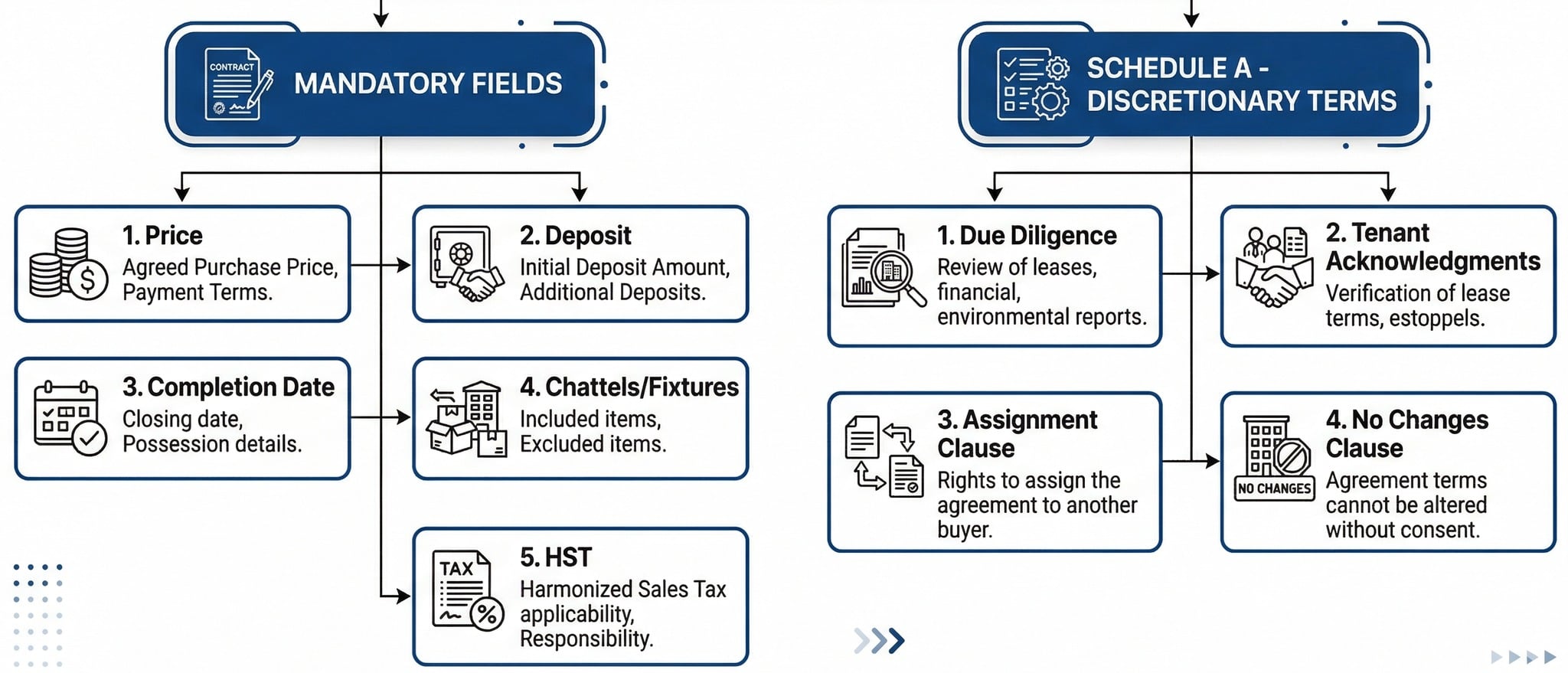
The commercial Agreement of Purchase and Sale is divided into two distinct sections: the standard mandatory fields and the discretionary terms found in Schedule A. The mandatory fields lay the transactional foundation:
- The Basics: This includes the buyer and seller names, property address, legal description, purchase price, irrevocability (the 2-3 days given to respond), and the completion date.
- Structured Deposits: Unlike residential deals with a single deposit, commercial transactions often utilize a series of deposits. For example, you might provide an initial $100,000 upon acceptance, and an additional $100,000 only after the successful completion of your due diligence period.
- Chattels vs. Fixtures (The Shake Test): It is vital to specify exactly what stays with the property. Imagine turning the building upside down and giving it a shake: everything that falls (like say coin-operated washers and dryers) is a "chattel". If you do not explicitly list chattels in the offer, the seller can legally take them. Anything that stays attached is a "fixture" and remains with the property unless explicitly excluded. it of course is also common to note that all fixtures belonging to tenants are not included.
- Commercial HST: On the commercial side, HST is always deemed to be in addition to the purchase price, when applicable. While a purely residential resale multi-family building is generally exempt from HST, mixed-use properties are not. If you buy a building with apartments on top but a dry cleaner and a corner store on the ground floor, HST will be attached to the commercial portion's value.
Phase 3: Crafting Schedule A (Discretionary Terms)
Schedule A is where we tailor the contract to fiercely protect you, the buyer, and account for the specific building. Essential clauses include:
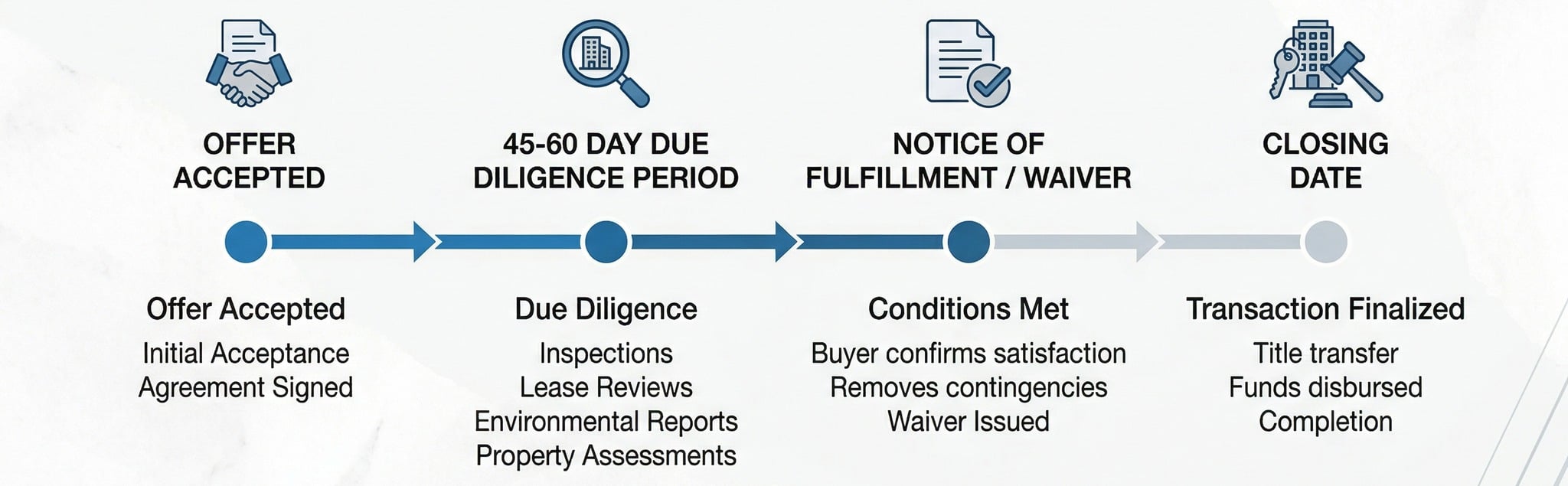
- Comprehensive Due Diligence Instead of brief, separate clauses for financing and inspections, commercial deals use one overarching due diligence clause that typically lasts 45 to 60 days. This grants you the right to perform "any and all due diligence" you deem necessary—from reviewing leases and financial statements to conducting environmental and structural inspections. The seller must provide you with unfettered access to the property with reasonable notice (e.g., 24 to 48 hours to notify tenants). Crucially, this is done at your "sole and absolute discretion". If you are not completely satisfied at the end of the 45 or 60 days, you simply withhold the Notice of Fulfillment, the deal becomes null and void, and your deposit is returned in full without deduction.
- Tenant Acknowledgments You must verify that the seller's provided rent roll matches the reality of what the tenants are actually paying. A Tenant Acknowledgment clause requires the seller to get signed forms from each tenant verifying their exact rent and inclusions within five days of condition removal. This uncovers hidden side deals, such as a landlord secretly lowering rent because of a broken appliance, or a tenant refusing to pay a parking fee listed on the lease. If a tenant is unavailable, the landlord must sign on their behalf and legally warrant that the terms are accurate.
- The Assignment Clause We typically draft the buyer's name as "[Your Name] or Corporation to be formed". This allows you to assign the purchase to a dedicated holding corporation prior to closing for tax and liability structuring. However, it is important to note that if your newly formed corporation (or any assignee) fails to close the deal, you, as the original named buyer, remain legally on the hook.
- The "No Changes" Clause From the exact date your offer is accepted, the seller is legally prohibited from entering into new service or maintenance contracts, altering existing tenancy agreements, or renting out vacant units without your explicit written permission. Because your offer is based on the building's current financial reality, the seller cannot unilaterally offer rent discounts or change the garbage removal contracts while you are in your due diligence period.
Secure Your Next Commercial Investment
Successfully navigating a commercial real estate transaction requires precision, market knowledge, and an expertly crafted offer that leaves nothing to chance. If you are looking to expand your portfolio let’s connect.
Contact Terry Riddoch today to discuss your commercial real estate strategy. 📱 Cell: 519-591-1725 ✉️ Email: [email protected] 🌐 Website: www.TerryRiddoch.ca
Check out this article next