
At A Glance
- Council adopted the interim risk management framework on June 3 and authorized an additional 15 L/s of temporary pumping from Wilmot Centre, on top of the 5 L/s expected by end of September.
- The combined 20 L/s is enough water for roughly 3,649 new residential units (about 7,000 residents) by Q3 2026. Meaningful, but well short of a normal year.
- Kitchener gets 51.1%, Waterloo 24%, Woolwich 14.8%, Cambridge 10.1%, Wilmot 0.01%. Local allocation policies in Kitchener and Waterloo are due later this month.
- The 20% resiliency buffer is now officially a range. Staff have confirmed it could drop as low as 12% over the next five years.
- The structural fix (the Cam 2W pumping station connecting Mannheim and Middleton) is still 2030, with about 602 L/s of new capacity by 2031.
- The damage already done: 5,000+ homes stalled, 1,500 jobs lost, $500M+ in private investment at risk, around $100M drop in Regional development charge revenue.
- Industry has organized under the Reopen Waterloo Region coalition (WRHBA, GVCA, Build Urban, Cornerstone, CHCA) with a seven-point ask.
- Wilmot has asked the Region to delay the additional 15 L/s. Expect this to become a political issue over the summer.
It has now been six months since the Region of Waterloo formally identified the water capacity constraint in the Mannheim Service Area and effectively paused new development approvals across Kitchener, Waterloo, and portions of Cambridge, Woolwich, and Wilmot. Since our February update the conversation has shifted from whether anything can move to how much, for whom, and when. Yesterday's special council meeting produced the first concrete answers we have had on any of those questions since this began. The answers are partial, and frankly, somewhat unsatisfying.
Here is where things stand as of today.
What Council Actually Approved on June 3rd
After roughly six months of staff work, three formal scenarios were placed in front of Regional Council on Wednesday:
- Scenario 1: Optimized planning to reliably supply water (the baseline).
- Scenario 2: Defer planned shutdowns until the Mannheim sidestream treatment is fully operational. Staff recommended this one, citing the lowest cumulative risk score (161 out of a possible 325).
- Scenario 3: Temporarily extend pumping at select wells until Mannheim sidestream is fully operational.
Council adopted the interim risk management framework along with staff's recommendation. Just as critically, they also authorized the temporary extraction of an additional 15 litres per second (L/s) from a Wilmot Centre well, on top of the 5 L/s that the four major engineering milestones are expected to free up by the end of September.
The combined effect is enough water to accommodate roughly 3,649 new residential units, or about 7,000 additional residents, by Q3 of this year. That number is real, but it should be read in context (see below).
The Allocation Split
The 20 L/s of new capacity will be divided between the area municipalities along these lines:
- Kitchener: 51.1%
- Waterloo: 24.0%
- Woolwich: 14.8%
- Cambridge: 10.1%
- Wilmot: 0.01%, effectively one person's worth
A reserve of 2.64 L/s in both the 5 L/s and 20 L/s scenarios is being set aside for registered but unbuilt units, meaning approved housing on registered subdivision plans that have not yet been constructed. Kitchener and Waterloo planning staff are now in the process of drafting their own local-level allocation policies; a report to Waterloo Council is expected in late June.
About That "20% Buffer": It's Now a Range
Readers of my earlier piece will recall that the 20% Operational Resiliency Buffer is the policy lever that turned a 96%-capacity system into a deficit overnight. One quiet but important change came out of this week's clarifications: the 20% number is no longer a hard floor. Regional staff have confirmed that the buffer will fluctuate, and over the next five years could drop as low as 12%. That is a meaningful policy concession, and one the industry has been pushing for since this began.
Staff laid out a longer-arc roadmap that is genuinely useful for anyone trying to underwrite a project in this market:
- End of September 2026: Four milestones complete (the Wilmot 1980 policy repeal, Mannheim stress test, Parkway extended pumping, and Phase 1 of the Mannheim sidestream pilot using a mobile filtration trailer rated at 25 L/s). Net new Mannheim capacity: 76 L/s.
- 2027 onward: Mannheim sidestream Phase 2 (full ultrafiltration buildout), Maple Grove, Greenbrook WTP, and Grand River supply projects continue.
- 2030: The Cam 2W pumping station comes online, finally connecting the Mannheim and Middleton service areas. This is the piece that ends the "island" problem I wrote about in February.
- 2031: Estimated total new capacity in the system of approximately 602 L/s, sufficient to meet projected growth demand through that horizon.
The Economic Damage Already Done
It's important not to lose sight of what this freeze has already cost. The Waterloo Region Home Builders' Association surveyed 12 member groups (Activa, Thomasfield Homes, Mattamy, Build Urban, and others) and reported:
- More than 5,000 homes stalled in the planning queue
- Approximately 1,500 jobs lost. That's the WRHBA's number; actual losses across trucking, warehousing, sales and trades are larger.
- More than $500 million in private investment at risk
- No new building permits issued in the constrained area since December 2025
The carrying costs are punitive. Tom McLaughlin of Thomasfield Homes shared a useful illustration: on a $35 million Waterloo development site, every month of delay represents roughly $240,000 to $250,000 in extra costs, with roughly $218,000 of that being interest at current Ontario lending rates of around 7.5%. As McLaughlin pointed out, those costs end up baked into the per-unit price of every home on the site.
The municipal revenue picture is no less stark.
The Region is projecting development charge revenue to fall from over $120 million in 2025 to under $20 million in 2026, close to a $100 million decline. Some of that is attributable to Bill 17, which moved DC collection from the building-permit stage to the date of occupancy. But a significant portion is the freeze. Kitchener alone is forecasting more than a $13 million drop year-over-year. These are the dollars that pay for roads, recreation projects, and (somewhat ironically) water treatment infrastructure.
The Industry Has Organized
The development and construction industry has consolidated under a single coalition called Reopen Waterloo Region, with the WRHBA, GVCA, Build Urban, Cornerstone, and the CHCA as founding partners. Their public positioning is worth reading in full, but the technical critiques boil down to four points worth understanding:
- The 20 to 30% resilience buffer was introduced without industry consultation
- Modelling relied on what they describe as "extreme and unlikely" scenarios
- Up to 40% of the intended Mannheim capacity is being lost to overlapping constraints (i.e., risk factors being counted twice, once through provincial permitting, and again through the Region's methodology)
- Interim engineering solutions were, in their view, under-considered
Their seven-point ask includes deploying the nearly $100 million in available DC reserves, advancing shovel-ready projects already in the Region's capital plan, reassessing past well studies, and expanding system interconnections. Whatever you think of the rhetoric, the substantive points deserve attention.
Wilmot Has Pushed Back
A complication worth flagging: even with the 15 L/s temporary Wilmot pumping authorized, the Township of Wilmot has formally asked the Region to delay the additional water taking. Wilmot declined to participate in the interim risk management framework working group from the outset. Their growth areas (Baden and New Hamburg) are outside the Mannheim Service Area, and they have understandably been protective of their groundwater. Don't be surprised if this becomes a political flashpoint over the summer.
Why the Krauss/Northfield Story Matters
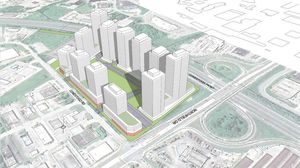 Solowave Investments' redevelopment of the former Krauss carpet factory at 65 Northfield Drive in Waterloo (a 17-floor, 235-unit building inside a larger 12-tower, 3,300-unit plan) has been denied a building permit despite the fact that the site is already serviced with water. The Region's position is that the site's prior industrial allocation was revoked when industrial use ended.
I flag this because it tells us something about how strictly the Region is interpreting "no new demand." If a serviced industrial-converted site can't proceed on its historic allocation, expect the same logic to apply to other infill and conversion projects. This is the kind of edge case where the lifted-freeze categories the Region published earlier this spring (schools, child care, religious institutions, certain commercial, and residential with no new water demand) start to feel narrower than they read on paper.
The Bottom Line for Investors
The headline is straightforward: the freeze is no longer total, but it is also nowhere close to over.
- Allocation is now real, but small. 3,649 units across five municipalities is not a normal year's worth of starts. Kitchener and Waterloo will set local prioritization rules later this month, and those rules will matter as much as the regional split.
- Holding Provisions are still the default. If you are buying land, continue to underwrite for an "H" on title. The path to lifting them is clearer than in February, but the timeline still runs out to 2030 or 2031 for the structural fix.
- The 12% floor matters. The buffer being a range rather than a hard 20% gives the Region more flexibility to release water to development. Watch for staff to use it.
- Construction season is half gone. As the WRHBA noted, the season runs May through November. We have already lost a meaningful portion of 2026, and that damage is permanent regardless of what happens next.
- The litigation and political pressure are now real. The industry coalition, the federally-backed project at risk of redirecting to another city, and MPP Mike Harris's letter to Minister Rob Flack all point to mounting external pressure on the Region. Expect more of it.
Whether the June 3 decision is enough to actually move projects is a question that will be answered in the next 60 to 90 days, as Kitchener and Waterloo publish their allocation frameworks and as the September milestones (the mobile filtration trailer in particular) either deliver on promise or don't. As always, I will continue to follow this and report back.
Terry Riddoch
 If you would like to talk through how any of this applies to a building you own or one you are considering, I am always happy to walk through the numbers.
Terry Riddoch
Real Estate Broker -- Multifamily and Investment Properties, Ontario
Phone: 519 591 1725
Email: [email protected]
Web: www.terryriddoch.ca
Sources: Region of Waterloo staff reports and meeting materials, Waterloo Region Record, CBC News, Reopen Waterloo Region
About the Author: Terry Riddoch, Ontario Multi-Family and Commercial Real Estate Broker
 Terry Riddoch is a licensed Ontario real estate broker with Re/Max Real Estate Centre, based in Waterloo Region and specializing in multi-family and apartment building sales across Ontario. With 19 years of experience and over $90 million in closed transactions, he advises independent landlords, private investors, and national investment groups on buying, selling, and valuing apartment buildings, investments and development land across the Province of Ontario including Waterloo Region (Kitchener, Waterloo and Cambridge), Guelph, Brantford, Hamilton, London, Milton, Windsor, Kingston, Belleville, Brockville and Sudbury.
Clients know Terry for candid advice, data-driven analysis, and doing the work well ahead of the deal. He writes regularly on Ontario landlord rules, rent control, the Landlord and Tenant Board, and housing policy to help property owners make informed decisions.
Thinking about selling an apartment building, or looking for your next investment property? Call Terry at (519) 591-1725, email [email protected], or visit terryriddoch.ca for a confidential, no-obligation conversation about your property.
Check out this article next