
At A Glance
- London, Ontario has the worst downtown office vacancy rate in Canada at 31.5% as of Q4 2025.
- In response, the city launched the Office-to-Residential CIP Incentive program in February 2024. It pays developers $35,000 per unit (originally $28,000, raised in July 2024) as a forgivable loan.
- The program is backed by $10 million in city funding, drawn from a $74 million federal Housing Accelerator allocation. The target is 285 new units.
- Three projects are already moving: Bluevale Capital's 23-unit conversion at 376 Richmond Street (completed September 2025), Sifton Properties' 94-unit project at 195 Dufferin Avenue (completed April 2026), and FHC's 32-unit conversion at 166 Dundas Street.
- Farhi Holdings, one of London's largest downtown property owners, has publicly stated it plans additional conversions using the incentive.
- For Ontario landlords and developers watching the conversion theme, London is the case study to follow. The math, the timing, and the political backing all work in a way they currently don't in Toronto or Montreal.
The problem London is trying to solve
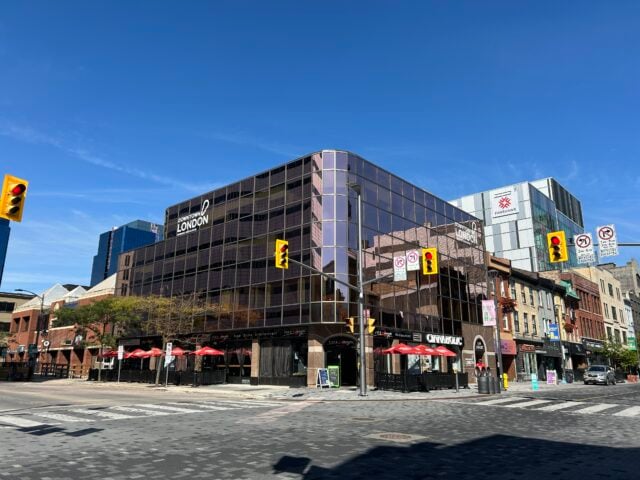
London has a downtown vacancy problem that isn't just bad. It's the worst in the country. CBRE pegged London's downtown office vacancy rate at 31.5% in Q4 2025, up from 30.6% the prior quarter. The city-wide rate is 20.0%, which by itself would be elevated, but the downtown story is structurally worse.
The cause is familiar but particularly acute in mid-sized Ontario cities. Companies need less office space than they used to (remote work has stuck), and when they do lease, they want newer, higher-quality buildings. That leaves a lot of Class B and Class C product, the older mid-rises that defined downtown London for decades, sitting empty.
For property tax revenue, for downtown vibrancy, and for the small businesses that rely on office workers showing up, this is a problem the city couldn't ignore. The question was what to do about it.
The program
In February 2024, London City Council approved the Office-to-Residential CIP Incentive program. The grant amount started at $28,000 per residential unit created. In July 2024, council bumped it to $35,000 per unit. The structure is a forgivable loan, which means developers don't repay it as long as they meet the conditions (essentially, deliver the units and keep them in residential use).
The eligibility rules are tight. The property has to sit within the Downtown Community Improvement Project Areas. It has to be a vacant Class B or C office building. The application has to be submitted before construction starts, with no retroactive funding. The owner must keep at least 10% equity in the property after the improvement, which prevents purely speculative refinances. And there can't be outstanding debts owed to the city.
The funding pool is $10 million, drawn from a much larger $74 million federal commitment under the Housing Accelerator Fund. The target output is 285 new residential units over the program's life.
What's actually been built
This is the part that makes London different from most cities talking about conversions. Three projects are already on the ground or close to it.
The first conversion was Bluevale Capital's 376 Richmond Street project, branded "376 Lofts," which delivered 23 units and opened in September 2025. The largest to date is Sifton Properties' 195 Dufferin Avenue project: a former office tower converted into 94 apartment units, completed in April 2026. The 94-unit project reportedly drew about $3.29 million in municipal grants, which is consistent with the $35,000-per-unit incentive.
A third project is in the pipeline. FHC's 166 Dundas Street conversion is producing 32 units, with delivery in Q1 2026. Together, the three projects represent roughly 149 units, more than halfway to the program's 285-unit target. And the city says additional applications are in the queue. Farhi Holdings, one of London's largest downtown property owners, has publicly stated it intends to convert several more buildings using the incentive.
The Economics
For an office building owner considering conversion, the question is whether the math actually pencils.
A Class B or C office tower in downtown London might sell for as little as $50 to $100 per square foot in today's market, because there's no realistic prospect of leasing it as office space at anything resembling historical rents. But conversion costs are real. Industry estimates put a typical office-to-apartment conversion at $10 million or more for a mid-sized downtown building, including structural work, MEP system replacement, fire and life safety upgrades, and unit fit-out.
The $35,000-per-unit incentive doesn't change the project from impossible to easy. What it does is move marginal projects across the line. For a 90-unit conversion, the city contribution is just over $3 million, which is roughly 30% of the conversion budget for a typical building of that size. Pair that with development-charge exemptions some downtown projects qualify for, and federal financing through CMHC's MLI Select (which works particularly well on conversions), and the IRR can start to clear the threshold a private developer needs.
It's worth noting what the incentive doesn't solve. Structural feasibility (floor plate depth, window placement, mechanical chases) still has to work. Demographics around the building still have to support residential rents. And construction risk on a 1960s or 1970s office tower remains real. But for the right asset, $35,000 a door is the kind of subsidy that turns a "no" into a "maybe" and a "maybe" into a "yes."
What this means for Ontario investors
London is interesting for a few reasons that extend well beyond London.
First, it's a proof of concept other Ontario cities are watching. Industry coverage in early June reported that municipalities across Canada are studying London's approach, with the program explicitly cited as the leading model. Toronto is currently running an Office Space Needs Study, which is often a precursor to policy. Hamilton, Kitchener, and Ottawa all have downtown office vacancy at concerning levels. If any of these cities adopts a similar program, the timeline from policy announcement to underwriting opportunity is short.
Second, the deal pipeline London has generated suggests there's investor appetite for these conversions when the incentive is there. Bluevale, Sifton, and Farhi are not speculative new entrants. They're established players who concluded the math works. That signals to capital partners (private REITs, family offices, and the new wave of private apartment funds we've written about) that conversion product is a legitimate acquisition channel, not just a planning-document fantasy.
Terry Riddoch
 If you would like to talk through how any of this applies to a building you own or one you are considering, I am always happy to walk through the numbers.
Terry Riddoch
Real Estate Broker -- Multifamily and Investment Properties, Ontario
Phone: 519 591 1725
Email: [email protected]
Web: www.terryriddoch.ca
Sources: City of London, CBC News, Ontario Construction News, Bluevale Capital press release, Sifton Properties, industry coverage of Canadian commercial real estate.
About the Author: Terry Riddoch, Ontario Multi-Family and Commercial Real Estate Broker
 Terry Riddoch is a licensed Ontario real estate broker with Re/Max Real Estate Centre, based in Waterloo Region and specializing in multi-family and apartment building sales across Ontario. With 19 years of experience and over $90 million in closed transactions, he advises independent landlords, private investors, and national investment groups on buying, selling, and valuing apartment buildings, investments and development land across the Province of Ontario including Waterloo Region (Kitchener, Waterloo and Cambridge), Guelph, Brantford, Hamilton, London, Milton, Windsor, Kingston, Belleville, Brockville and Sudbury.
Clients know Terry for candid advice, data-driven analysis, and doing the work well ahead of the deal. He writes regularly on Ontario landlord rules, rent control, the Landlord and Tenant Board, and housing policy to help property owners make informed decisions.
Thinking about selling an apartment building, or looking for your next investment property? Call Terry at (519) 591-1725, email [email protected], or visit terryriddoch.ca for a confidential, no-obligation conversation about your property.
Check out this article next