

As a real estate professional working with landlords and investors, one of the most frequent questions I receive is: “How exactly do you figure out what this property is worth?”
Whether you are seeking valuation for financing, insurance, or a potential resale, appraisers and real estate brokers rely on three primary methods to price a property. Depending on the type of building and the purpose of the valuation, certain methods will be more appropriate than others.
The Cost Approach
The cost approach seeks to assign a value to a building based strictly on its replacement costs. When using this method, we look at the exact price of the land, labor, and materials needed to rebuild the property from scratch. We calculate the cost of a cubic yard of cement, a two-by-four, and the hourly rates of plumbers, electricians, and carpenters to create a fairly accurate picture of the building's value.
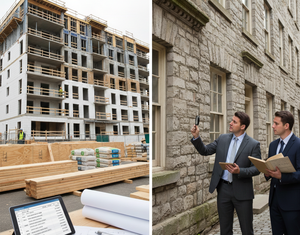
When is it best? This approach is highly appropriate for relatively new buildings where the current prices of labor and materials are well-documented. However, the further back in time you go, the more problematic this method becomes. If you are trying to value a 200-year-old historic building, it can be incredibly tricky to estimate the cost of a cubic yard of historic limestone or find the going rate for a specialized stone mason.
The Comparative Approach
If you have ever bought or sold a single-family home, you are likely familiar with the comparative approach, as it is used almost exclusively by residential agents. This method involves finding recent, market-proven sales of "comparable" properties—homes in the same neighborhood with a similar age and state of repair—to determine a subject property's value.
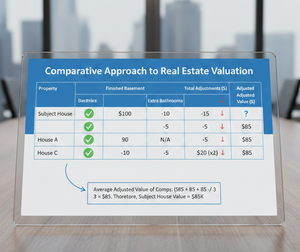 How does it work? Because no two properties are ever truly identical, the trick to this approach is making adjustments. For example, if a comparable home sold for a certain price but has an extra bathroom or a finished basement, we look at market data to see exactly how much buyers are willing to pay for those specific features. If the market pays $50,000 for a finished basement and $5,000 for an extra bathroom, we adjust the comparable sales prices up or down to accurately reflect the value of the subject property.
The Income Approach (The Investor’s Best Friend)
For landlords and investors dealing with assets like apartment buildings or duplexes, the income approach is generally the best valuation method. Instead of looking at replacement costs or neighborhood comps, this approach assigns a value to a building based entirely on the income it currently produces or could produce in the future.
To master the income approach, you need to understand two key concepts: Net Operating Income (NOI) and the Capitalization Rate (Cap Rate).
- Net Operating Income (NOI): Think of this as all the money going into your bank account minus all the money going out, calculated before your mortgage. First, you calculate the Gross Annual Income, which includes unit rent plus any additional revenue like parking or laundry fees. Then, you subtract your Total Annual Expenses, which include property taxes, utilities, insurance, and maintenance.
- Capitalization Rate (Cap Rate): The cap rate is the ratio between the rent you collect and the proposed purchase price. Simply put, it tells you how many cents you will get in rent for every dollar you spend on the property. To find the market cap rate, we look at past sales of similar apartment buildings, find out what cap rates those properties sold at, and calculate an adjusted average by removing any extreme outliers.
 The Valuation Formula:
Once you have these two numbers, you can easily solve for the property's purchase price. By dividing the Net Operating Income by the market Cap Rate, you get the building's value. For example, if you have a duplex with an NOI of $12,900 and the market cap rate is 4.5% (or 0.045), you simply divide $12,900 by 0.045 to arrive at a purchase price of $286,666.67.
Of course this is overly simplified, and pricing reality is far more complex, but at least this will give you a sense of how we begin.
Ready to Maximize Your Portfolio's Value?
Understanding the cost approach, the comparative approach, and the income approach is the key to making smart, profitable real estate decisions. But you don't have to navigate the math alone!
If you have a building you are thinking about selling, or if you are looking to acquire a new investment property and need an accurate market valuation, I would love to help.
Contact me today to schedule a professional property valuation and let’s ensure you are getting the absolute best return on your real estate investments!
Check out this article next