


The Big Picture: A Market in Transition
Ontario Markets City-by-City
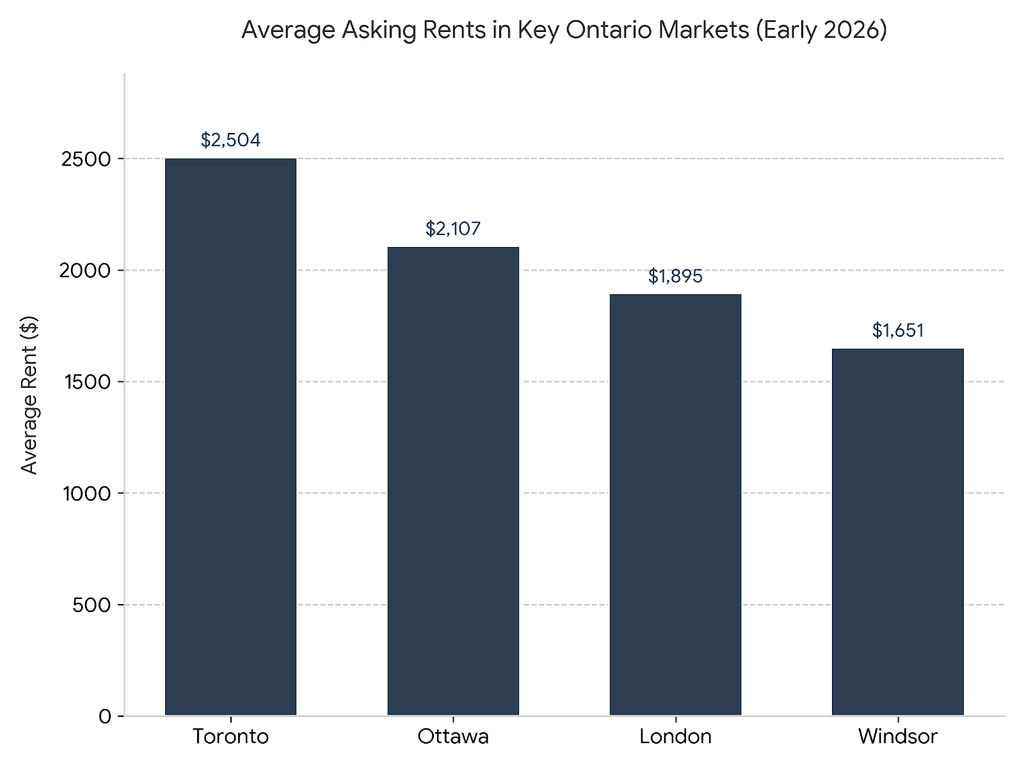
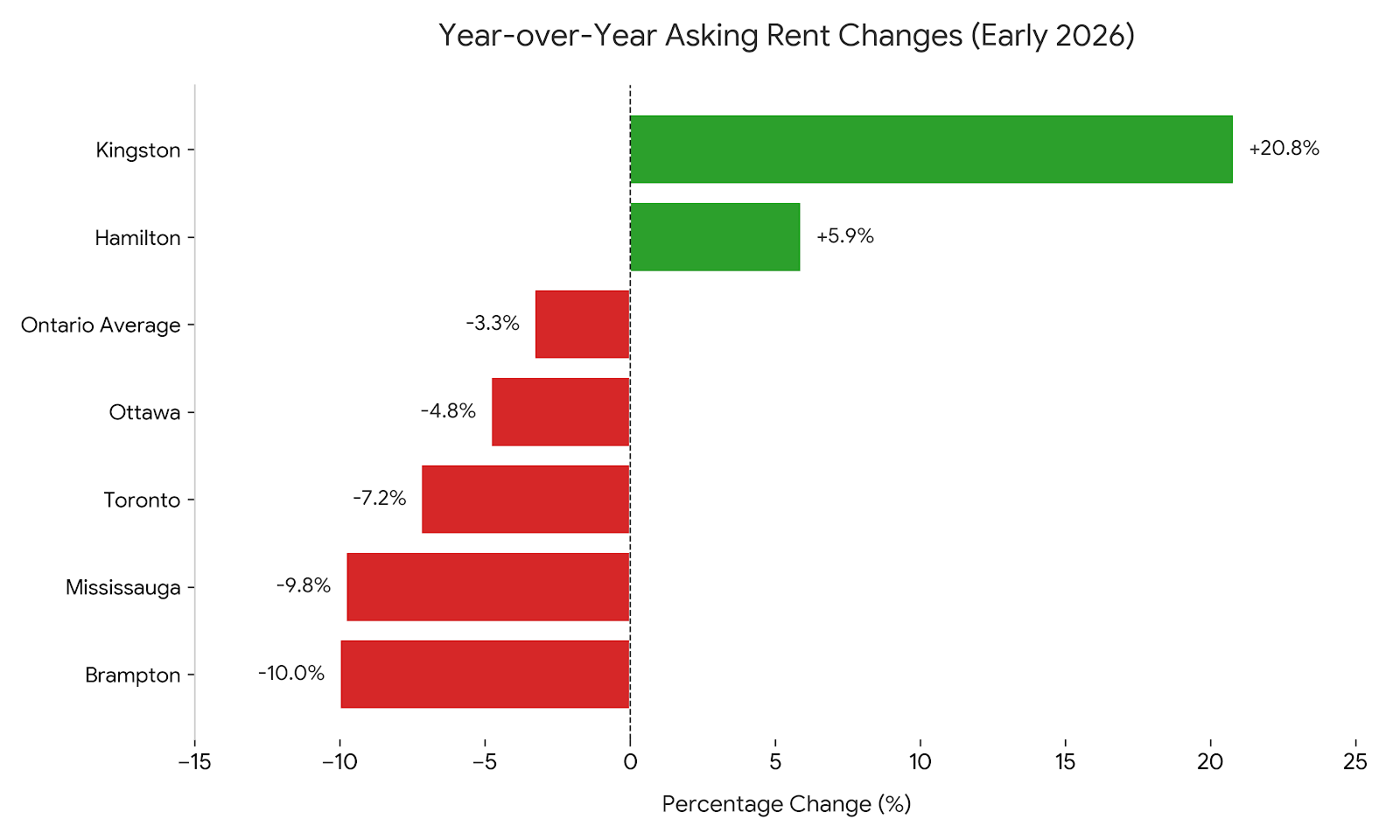
- Rental Rates: Asking rents in the City of Toronto have dropped 7.2% year-over-year to an average of $2,504. The decline is even sharper in the suburbs: Brampton (-10.0%) and Mississauga (-9.8%) have seen double-digit corrections in asking rents as affordability limits were hit.
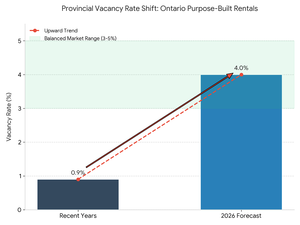
- Vacancy Trends: There is a distinct divergence in vacancy. The purpose-built rental vacancy rate has climbed to roughly 3%, driven by new supply and students doubling up or leaving. Conversely, the condo rental vacancy rate remains tight at roughly 1%, though this sector faces its own risks with negative cash flow for many investors.
- Landlord Watch: Watch "turnover rents." For the first time recently, rents for turnover units have decreased (down ~2.5%), meaning you may not be able to mark-to-market as aggressively when a tenant leaves.
- Rental Rates: Apartment rents in Ottawa have fallen 4.8% year-over-year to $2,107. Interestingly, shared accommodation rents in Ottawa bucked the trend, rising 7.4%, driven by new co-living projects entering the market.
- Vacancy Trends: Vacancy is rising faster than anticipated. The cap on international students and foreign workers has reduced demand significantly.
- Landlord Watch: With federal public service cuts looming as a potential risk, employment stability—usually Ottawa's strength—is now a question mark. Expect very modest rent growth, if any, capped by the provincial guideline of 2.1%.
- Rental Rates: Hamilton was Ontario’s rent growth leader early this year, posting a 5.9% increase in asking rents. This suggests that as tenants are priced out of the GTA, they are still driving demand in the Hammer.
- Vacancy Trends: Despite strong rent growth, vacancy rates are expected to keep climbing in 2026 as new rental supply and condo completions hit the market simultaneously.
- Landlord Watch: The window to push rents here may be closing as the market balances out by 2027.
- Rental Rates: Rents in London are essentially flat, hovering around $1,895. Kitchener-Waterloo-Cambridge is seeing a similar trend, with average prices expected to remain flat throughout 2026 before recovering in 2027.
- Vacancy Trends: Vacancies are rising in both regions. The reduction in international study permits is hitting these university-heavy towns directly, reducing the number of renter households formed.
- Landlord Watch: In Kitchener-Waterloo and the north of Cambridge, infrastructure constraints have paused some new development approvals. Click here for more details. This supply constraint might protect existing landlords from competition in the medium term, even if demand is soft right now.
- Rental Rates: Windsor is seeing modest rent growth but sits at the lower end of the pricing spectrum at $1,651. St. Catharines-Niagara is seeing improved affordability help sales, but rental demand is tempered by fewer intra-provincial migrants.
- Vacancy Trends: Vacancies are rising in Windsor as the number of work-permit holders—a key demographic for the city—declines.
- Landlord Watch: Windsor is heavily exposed to trade uncertainty. With ongoing tariff uncertainty and the CUSMA review in 2026, manufacturing employment could wobble, which would directly impact tenant solvency.
2026 Forecast: The Numbers
- Vacancy Rates: Expect a province-wide increase. The days of sub-1% vacancy are largely behind us for the near term. Consensus among researchers project broadly balanced conditions (3%+) across most major Ontario CMAs
- Rental Rates: We are witnessing a decoupling of asking rents versus current rents. Asking rents in Ontario dropped 3.3% year-over-year in January 2026. However, average rents (including occupied units) will see modest growth, capped by the provincial guideline of 2.1% for 2026 and turnover adjustments.
- Construction: While overall housing starts are declining due to high costs, purpose-built rental construction remains the primary driver of new supply in Ontario, outpacing condo and homeowner starts
Things Landlords Must Watch in 2026
- The "Turnover" Gap and Tenant Retention With asking rents softening and vacancy options increasing, tenants are becoming more mobile. The gap between market rent and occupied rent is narrowing in some segments, which may encourage tenants to move for better amenities or incentives. Landlords should focus heavily on retention; the cost of turning over a unit in a 4% vacancy market is significantly higher than in a 1% market.
- Delinquencies and Arrears Economic uncertainty remains a headwind. While mortgage arrears are low, we are seeing rising non-mortgage arrears (e.g., credit cards, car loans) in regions like Southwestern Ontario. This is typically a leading indicator of financial stress. Vetting tenant creditworthiness is more critical now than it was two years ago.
- Trade Policy Impacts Ontario’s economy is sensitive to cross-border trade. With the CUSMA review scheduled for 2026 and tariff uncertainty with the U.S., regions heavily reliant on manufacturing (Windsor, parts of the GTA) could see fluctuations in employment, directly impacting rental demand.
The Bottom Line
About the Author: Terry Riddoch, Ontario Multi-Family and Commercial Real Estate Broker
 Terry Riddoch is a licensed Ontario real estate broker with Re/Max Real Estate Centre, based in Waterloo Region and specializing in multi-family and apartment building sales across Ontario. With 19 years of experience and over $90 million in closed transactions, he advises independent landlords, private investors, and national investment groups on buying, selling, and valuing apartment buildings, investments and development land across the Province of Ontario including Waterloo Region (Kitchener, Waterloo and Cambridge), Guelph, Brantford, Hamilton, London, Milton, Windsor, Kingston, Belleville, Brockville and Sudbury.
Clients know Terry for candid advice, data-driven analysis, and doing the work well ahead of the deal. He writes regularly on Ontario landlord rules, rent control, the Landlord and Tenant Board, and housing policy to help property owners make informed decisions.
Thinking about selling an apartment building, or looking for your next investment property? Call Terry at (519) 591-1725, email [email protected], or visit terryriddoch.ca for a confidential, no-obligation conversation about your property.
Check out this article next