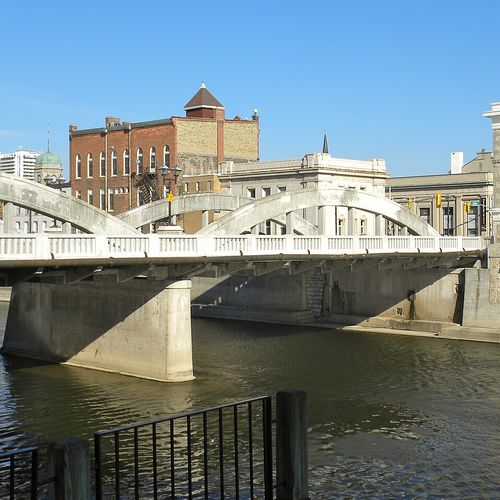

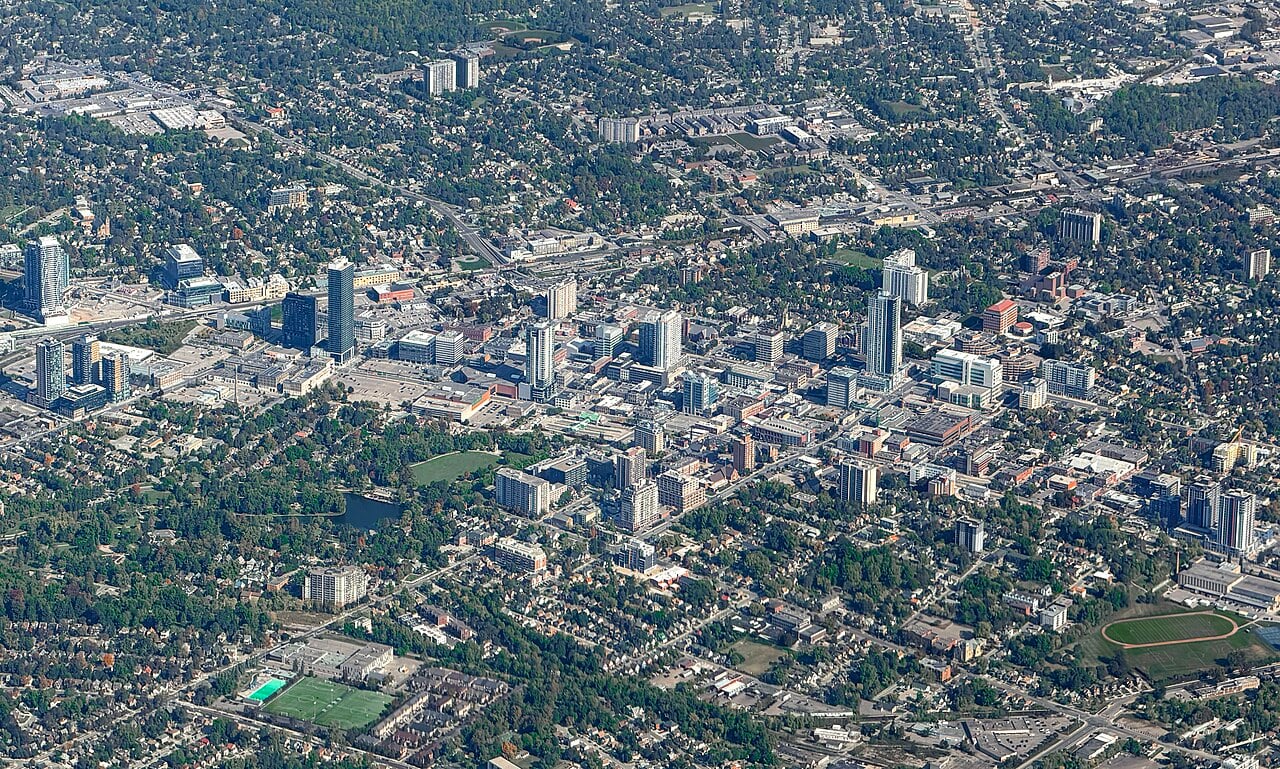
Photo: Quintin Soloviev, CC BY 4.0, via Wikimedia Commons
Kitchener is the largest city in Waterloo Region and one of Ontario's most renter-heavy mid-sized markets. Four in ten households rent [1]. Over the past ten years the city added people at twice the provincial pace [2], and the rental market is now absorbing what that boom left behind: a wave of new rental construction, fewer international students, and the highest vacancy rate in at least ten years [3].
The short answer: for an owner planning to hold for five years or more, yes. For anyone counting on quick rent growth, not right now. The numbers behind that answer follow, and the full verdict is at the end of this post.
This primer is for anyone thinking about buying, selling or holding a multi-family building in Kitchener. It leaves cap rates and this month's pricing aside and looks at what drives a building's income over a hold of five years or more: who rents here, what pays their rent, what the rental stock looks like, and which local rules and projects could change the math.
Note: Sources are cited with a number in square brackets, like [1], and listed with hyperlinks at the bottom of this post.
At a glance
- Kitchener had an estimated 323,917 residents on July 1, 2025, up 37.6% in ten years. Ontario grew 18.6% over the same period [2].
- 40.3% of households rent, against 31.4% across Ontario. About seven of every ten households added between 2016 and 2021 were renters [1][4].
- The median age is 37.2, more than four years younger than Ontario's 41.6 [1].
- Growth has stalled for now. The wider area gained more than 27,000 non-permanent residents in each of two years, then lost 7,365 in the year to July 2025 [5].
- The wider area had 389,100 people working in 2025, up from 289,800 in 2015. Unemployment was 7.7% in September 2026, against 6.9% for Ontario [6][7].
- Consumer insolvencies in the Kitchener area ran at 3.1 per 1,000 adults in 2025, below Ontario's 3.9 [8][9].
- Purpose-built rental vacancy in the city was 4.6% in October 2025, up from 1.2% in 2022. The average two-bedroom rent was $1,747 [3].
- 3,378 rental units were under construction in the city in August 2026, equal to about 14% of the existing purpose-built stock [3].
- Kitchener does not license ordinary rental apartments. A renovation licensing by-law takes effect January 1, 2027 [10][11].
Where is Kitchener?
Kitchener sits about 105 km west of downtown Toronto and about 85 km from Pearson Airport [12]. It shares a continuous urban area with Waterloo and Cambridge, and the three cities plus four townships make up Waterloo Region. Most jobs and migration data is published for the combined Kitchener-Cambridge-Waterloo area, so where a number below covers the wider area, I say so.
GO Transit runs 11 weekday trains each way to Union Station, a trip of 94 to 112 minutes [13]. The ION light rail line, opened in June 2019, runs from Fairway station in Kitchener to Conestoga station in north Waterloo [14]. The Region of Waterloo International Airport, just east of the city, handled more than 426,500 passengers in 2025 [15].
Who rents in Kitchener?
At the 2021 Census, 40,235 Kitchener households rented, or 40.3% of the total. The Ontario figure was 31.4% [1]. The renter share has risen at every count: 35.0% in 2011, 37.9% in 2016 and 40.3% in 2021 [4]. Between 2016 and 2021 the city added about 5,260 renter households and about 2,340 owner households, so roughly seven of every ten new households rented.
The city is young. The median age is 37.2, against 41.6 for Ontario, and 23.3% of residents are between 20 and 34, the prime renting years [1]. About 30% of residents are immigrants, and 6.4% arrived in Canada between 2016 and 2021, compared with 4.2% across Ontario [1]. Newcomers usually rent first.
Incomes sit a little under the provincial median. Median household income was $87,000 in 2020, against $91,000 for Ontario, and a full-year, full-time worker earned a median of $62,000 against $67,000 [1]. At the same count, 36.0% of tenant households spent 30% or more of their income on shelter, below Ontario's 38.4% [1]. Keep the date in mind. The average rent in CMHC's survey has risen about 32% since 2021 [3], and the next census income figures do not arrive until July 2027 [16].
Education levels help explain the job mix. Among residents aged 25 to 64, 34.0% hold a bachelor's degree or higher, slightly below Ontario's 36.8%, while 29.1% hold a college diploma or trades certificate, slightly above the province's 28.7% [1]. The university campuses are next door in Waterloo. Kitchener's own workforce leans toward college, trades and the plant floor, with 16.1% of the labour force in manufacturing against 8.9% for Ontario [1].
Is rental demand growing?
Over ten years, yes. Statistics Canada estimates Kitchener's population at 323,917 on July 1, 2025, up from 235,467 in 2015. That is 37.6% growth, against 18.6% for Ontario [2]. Over the past year, barely. Growth ran at 7.1% in the year to July 2023 and 6.4% the year after, then dropped to 0.9% [2].
The reason is in the components. In the wider area, non-permanent residents (mainly international students and temporary workers) added 28,259 people in 2022 to 2023 and 27,432 the following year. In 2024 to 2025 that group shrank by 7,365 [5]. Immigration held steady at roughly 9,300 to 10,600 arrivals a year, and births continued to outnumber deaths, which is why the population still edged up [5].
Conestoga College is the local face of that swing. Its international full-time enrolment went from 1,026 in fall 2015 to 32,016 in fall 2023, then fell to 23,298 in fall 2024 as the federal cap on study permits took hold [17][18]. At the main Doon campus in Kitchener, total enrolment went from 23,123 to 18,676 in that one year [17]. The College's 2026-27 business plan budgets for international enrolment to fall a further 69%, measured in student semesters [19].
The long-range plan still points up. Kitchener's new official plan, adopted by Council in June 2026 and awaiting provincial approval, forecasts 446,000 residents by 2051. It plans for an average of 2,100 new homes a year, 60% of them apartments, stacked townhomes and additional units [20].
What pays the rent?
The wider area had 389,100 people working in 2025, up from 289,800 in 2015, a gain of about 34% [6]. Manufacturing is the largest employer at 69,300 jobs, or 17.8% of the total, almost exactly its share a decade ago [21]. The big change is in professional, scientific and technical services, the category that holds most software and engineering work. It went from 21,400 jobs to 49,300 [21].
Within the city limits, Statistics Canada counts 20 workplaces with 500 or more employees, spread across technology, education, health care and manufacturing [22]. Google's engineering campus in downtown Kitchener has more than a thousand employees and capacity for 3,000 [12]. Software firms such as D2L, ApplyBoard, Vidyard and Miovision are based here, alongside manufacturers such as Dare Foods and Mitchell Plastics [12]. Conestoga College's main campus and the city's hospitals round out the list. Toyota's assembly plants, with 8,500 workers between Cambridge and Woodstock, are a short commute away [12].
The job market has softened. Local unemployment ran about a point below Ontario's through 2018. By 2025 the two were level at 7.7%. In September 2026 the local rate was 7.7% against 6.9% for the province, after peaking at 9.0% in April [6][7].
Trade is the exposure to watch. Statistics Canada estimates that 13.7% of jobs in the Kitchener-Waterloo-Barrie economic region depend on American demand for exports, against 9.3% nationally [23]. CMHC describes the area as one of Ontario's most tariff-exposed economies because of auto and parts manufacturing [18]. A tenant base tied to export manufacturing is a strength in good years and a risk in a trade dispute. I look at what the current dispute means for local owners in Trade Wars, CUSMA and Your Apartment.
How financially healthy are Kitchener's tenants?
A rent roll is only as good as the tenants' ability to pay. No public source measures that for one city's renters, so I read four official indicators together.
Start with insolvencies. The Office of the Superintendent of Bankruptcy counted 3.1 consumer insolvencies (bankruptcies plus consumer proposals) per 1,000 adults in the Kitchener area in 2025, down from 3.4 in 2024 [8]. Ontario was at 3.9 and Canada at 4.1 [9]. Among the ten Ontario metropolitan areas covered in this series, only Guelph was lower at 3.0. Greater Sudbury (4.9) and Belleville (5.6) were highest [8]. Most local filings are now consumer proposals, 2.5 of the 3.1, where the person keeps paying creditors under a negotiated deal. The local rate peaked at 7.4 in 2009 [8]. The figure covers all adults, owners and renters alike, so read it as a gauge of household financial stress in the city, not as a tenant default rate.
The census adds a view of renters specifically. In 2021, 19.8% of Kitchener tenant households were in core housing need, against 24.9% across Ontario, and 10.7% lived in subsidized housing, against 13.7% [1].
CMHC also surveys rent arrears, but it does not publish a figure for the Kitchener area. Across Ontario, 12.3% of purpose-built rental units had some rent in arrears in 2025, down from 14.3% in 2024, and the amount in arrears was 0.8% of the rent owed, down from 1.2% [24].
Put together, Kitchener's tenant base looks a little sturdier than the Ontario norm on debt and affordability, and weaker on jobs, with unemployment in the wider area at 7.7% against 6.9% for the province [7]. These are city-level gauges for pricing risk. They say nothing about any one applicant, and a regulation under Ontario's Human Rights Code sets out what a landlord may ask for and consider when choosing a tenant [25].
What does the rental stock look like?
CMHC counted 24,116 purpose-built rental units in the City of Kitchener in October 2025. About 55% were built before 1980, and about 31% have been built since 2000 [3].
For most of the last decade this was a landlord's market. Vacancy sat near 2% and touched 1.2% in 2022. It has since climbed to 4.6%, above Ontario's 3.2% [3]. Rents kept rising through the shift, though more slowly. The average two-bedroom went from $975 in 2015 to $1,747 in 2025, and the average increase on units surveyed in both years slowed from 7.8% in 2022 to 2.9% in 2025 [3].
The city-wide number hides a split by location. Apartment vacancy was 7.4% in Kitchener West, where CMHC says supply grew faster than the regional average, against 3.7% in Kitchener East and 3.3% in the centre [18].
It hides a bigger split by age of building. A two-bedroom in a building from 1960 to 1979 averaged $1,561, and vacancy in that group was 3.8%. In a building from 2000 or later the average was $2,071 and vacancy was 6.6% [3]. Across the wider area, vacancy for the cheapest quarter of units was 0.7%, and CMHC reports landlords of high-end units offering one to two months of free rent [18]. Older, lower-rent buildings are still full. Newer, higher-rent buildings are competing for tenants.
Rent control ties this together. Ontario's guideline (2.1% for 2026 and 1.9% for 2027) does not cover units first occupied after November 15, 2018, and it does not apply when a unit turns over [26]. For the notice rules and exemptions in detail, see How Ontario Residential Rental Increases Work. CMHC does not publish how many units are exempt. As a rough guide, its count of units in buildings from 2000 or later grew by about 3,700 between October 2018 and October 2025, equal to about 15% of today's stock [3]. In the older stock, turnover is where rent resets. Across the wider area, two-bedroom units that turned over in 2025 rented for an average of $2,111, against $1,768 for units that did not, and 16.1% of units turned over, up from 12.0% the year before [18]. That $343 gap was $471 a year earlier [18].
More supply is coming. Builders started 1,455 rental units in the first eight months of 2026, nearly double the total for all of 2025, and 3,378 were under construction in August [3]. CMHC forecasts vacancy across the wider area at 4.5% in 2026 and 4.7% in 2027 and 2028, with the average two-bedroom rent rising from $1,832 to about $2,000 by 2028 [27].
What are the local rules and costs?
Kitchener regulates landlords more lightly than some Ontario cities, with one change coming. The City does not license ordinary rental apartments or houses. It licenses lodging houses, meaning five or more renters sharing a kitchen and other areas [10]. That is a real difference from the City of Waterloo next door, which I cover in Waterloo's New Rental Licensing Bylaw: The 2026 Landlord's Guide. On January 1, 2027, a renovation licensing by-law takes effect. An owner who serves an N13 notice for renovations will need a City licence for that unit, applied for within seven days of serving the notice and supported by a qualified person's report that the work requires the unit to be empty. The application fee is $650, and fines run up to $25,000 for individuals and $50,000 for corporations [11].
Two other by-laws matter for redevelopment. A rental replacement by-law requires a permit to demolish or convert six or more rental units, with replacement units and tenant compensation [28]. Inclusionary zoning applies to projects adding 50 or more units near ION stations, but a provincial regulation exempts applications made before July 1, 2027 [29].
On costs, development charges on a new apartment unit in a central neighbourhood total roughly $34,300: $10,727 to the City and $23,570 to the Region, before the discounts for purpose-built rental [30]. On the operating side, older buildings in the multi-residential tax class pay a 2026 rate of 2.596346%, about 1.85 times the residential rate of 1.405998%. Buildings in the new multi-residential class pay the residential rate [31].
What could change the picture?
Water is the near-term constraint. In December 2025 the Region of Waterloo identified a capacity shortfall in the Mannheim Service Area, which supplies Kitchener, Waterloo and parts of Cambridge. Until capacity is restored, the Region is not supporting new official plan amendments, rezonings or subdivisions there [32]. Kitchener adopted a Water Allocation Policy in June 2026 to hand out restored capacity, and the first allocations were issued in August [32]. The Region expects to add up to 600 litres per second by 2032, nearly half of it in 2027 [32]. For owners of existing buildings, a slower approvals pipeline can mean less new competition a few years out. For anyone buying land or a redevelopment site, servicing is now the first question.
Transit is the long-term tailwind. Regional Council approved extending ION light rail 17 km from Fairway to downtown Cambridge in November 2025, at an estimated $3.13 billion, though the project is not yet funded [14]. The Kitchener Central Transit Hub at King and Victoria is in design, with opening targeted for 2029 or 2030 [14]. Two-way, all-day GO service is not in place. Metrolinx began an environmental assessment for a key section of the line in June 2026 and has not set a completion date [13].
Zoning already favours density. Starting in 2024, Kitchener removed parking minimums and density caps around its ION stations, and it allows up to four units on most low-rise residential lots [33]. Council has approved 25,316 housing units since 2022, against a provincial target of 35,000 homes by 2031 [34].
The risks are the ones already in the data: a trade dispute that hits manufacturing payrolls, a further drop in international students, and a supply wave arriving while population growth is flat.
The Kitchener scorecard
Here are the main numbers from this primer in one place, each with something to compare it to.
So, is Kitchener a good place to buy an apartment building?
For an owner planning to hold for five years or more, yes. For anyone counting on quick rent growth, not right now. Kitchener has the population, the jobs and the renter base that support apartment values over that kind of hold. The next two years look softer, because new buildings are arriving while population growth has stalled.
What works in its favour:
- A deep renter base. 40.3% of households rent, the median age is 37.2, and the population grew 37.6% in ten years [1][2].
- Jobs. The wider area added about 100,000 jobs in ten years, spread across manufacturing, technology, health care and education [6][21].
- Tenant finances. Consumer insolvencies run below the Ontario rate, and a smaller share of tenants is in core housing need than across the province [8][9][1].
- Full older buildings. Vacancy for the lowest-rent quarter of units in the wider area was 0.7% [18].
- Light local regulation. No licence is required for ordinary rental apartments [10].
What to watch:
- Supply. 3,378 rental units are under construction, and CMHC expects vacancy in the wider area to reach 4.7% in 2027 [3][27].
- Students and temporary residents. The group that drove the boom is now shrinking [5][17].
- Trade and jobs. 17.8% of jobs in the wider area are in manufacturing, and unemployment was 7.7% in September 2026 [21][7].
- Costs and servicing. Older buildings pay property tax at about 1.85 times the residential rate, and limited water capacity is slowing new approvals [31][32].
Who it suits. Buyers of existing, older buildings who price on the income in place and plan to hold. It is a harder market for a short hold that depends on rent growth, or for leasing up a new building over the next two years. This is a general view of the market, not advice on any particular property.
What it means for buyers, owners and sellers
For buyers. The numbers favour careful underwriting over speed. Older, rent-controlled buildings are still close to full, but the rent lift on turnover narrowed from $471 to $343 in a year, and nobody can schedule turnover. Underwrite the rent roll that exists. A building first occupied after November 15, 2018 is not capped by the guideline, but it is competing with 3,378 units under construction and with landlords offering free months.
For current owners. Keeping good tenants is worth more than it was two years ago. Vacancy in the lowest-rent units is under 1%, so a guideline increase on an older unit carries little vacancy risk. Serve the N1s. I work through what a skipped increase costs in cash flow and sale price in The N1 You Skipped Is Still Costing You. If a renovation that needs vacant possession is in the plan, the licensing rules change on January 1, 2027.
For sellers. Buyers and their lenders will price the income in place. A clean rent roll, a complete N1 file and a clear answer on each unit's rent control status will do more for your price than a story about upside.
Frequently asked questions
Is Kitchener a good place to invest in apartment buildings?
For owners planning to hold for five years or more, the fundamentals are strong: 40.3% of households rent, the population grew 37.6% in ten years, and consumer insolvencies run below the Ontario rate. The near term is softer. Vacancy rose to 4.6% in October 2025, 3,378 rental units were under construction in August 2026, and CMHC expects vacancy to keep rising through 2027. The market suits buyers of existing buildings priced on current income more than plans that depend on fast rent growth.
What is the rental vacancy rate in Kitchener, Ontario?
Canada Mortgage and Housing Corporation measured the purpose-built rental vacancy rate in the City of Kitchener at 4.6% in October 2025, up from 3.7% in 2024 and 1.2% in 2022. CMHC forecasts 4.5% for the wider Kitchener-Cambridge-Waterloo area in 2026 and 4.7% in 2027.
What is the average rent for an apartment in Kitchener?
In CMHC's October 2025 survey the average two-bedroom rent in purpose-built rentals in the City of Kitchener was $1,747 a month, and the average across all unit sizes was $1,632. Two-bedroom units in buildings from 2000 or later averaged $2,071, against $1,561 in buildings from 1960 to 1979.
Do landlords need a rental licence in Kitchener?
Not for ordinary rental apartments or houses. The City of Kitchener licenses lodging houses, meaning five or more renters sharing a kitchen and other areas. Starting January 1, 2027, a separate City licence is required for each unit where a tenant is served an N13 notice for renovations.
Are apartment buildings in Kitchener under rent control?
Yes, under Ontario's rules. The rent increase guideline is 2.1% for 2026 and 1.9% for 2027. Units first occupied for residential purposes after November 15, 2018 are exempt from the guideline, and the guideline does not apply when a unit turns over to a new tenant.
Is Kitchener's population still growing?
Slowly. Statistics Canada estimates the City of Kitchener had 323,917 residents on July 1, 2025, up 0.9% in a year after growth of 7.1% and 6.4% in the two years before. The slowdown follows a drop in non-permanent residents, including international students. Kitchener's new official plan forecasts 446,000 residents by 2051.
How far is Kitchener from Toronto?
Kitchener is about 105 km west of downtown Toronto by road and about 85 km from Toronto Pearson Airport. GO Transit runs 11 weekday trains each way between Kitchener and Union Station, taking 94 to 112 minutes.
About the Author: Terry Riddoch, Ontario Multi-Family and Commercial Real Estate Broker
Terry Riddoch is a licensed Ontario real estate broker with Re/Max Real Estate Centre, based in Waterloo Region and specializing in multi-family and apartment building sales across Ontario. With 19 years of experience and over $90 million in closed transactions, he advises independent landlords, private investors, and national investment groups on buying, selling, and valuing apartment buildings, investments and development land across the Province of Ontario including Waterloo Region (Kitchener, Waterloo and Cambridge), Guelph, Brantford, Hamilton, London, Milton, Windsor, Kingston, Belleville, Brockville and Sudbury.
Clients know Terry for candid advice, data-driven analysis, and doing the work well ahead of the deal. He writes regularly on Ontario landlord rules, rent control, the Landlord and Tenant Board, and housing policy to help property owners make informed decisions.
Thinking about selling an apartment building, or looking for your next investment property? Call Terry at (519) 591-1725, email [email protected], or visit terryriddoch.ca for a confidential, no-obligation conversation about your property.
Sources
- Statistics Canada, Census Profile, 2021 Census of Population: Kitchener (City), Kitchener-Cambridge-Waterloo (census metropolitan area) and Ontario. Incomes are for 2020.
- Statistics Canada, Table 17-10-0155-01, Population estimates, July 1, by census subdivision, released January 14, 2026. The 2025 figure is preliminary.
- Canada Mortgage and Housing Corporation, Housing Market Information Portal, City of Kitchener: Rental Market Survey (October 2015 to October 2025) and Starts and Completions Survey (to August 2026).
- Statistics Canada, Census Profile, 2016 Census, and National Household Survey Profile, 2011: Kitchener (City), households by tenure. The 2011 survey was voluntary.
- Statistics Canada, Table 17-10-0149-01, Components of population change by census metropolitan area, released January 14, 2026.
- Statistics Canada, Table 14-10-0461-01, Labour force characteristics by census metropolitan area, annual, and Table 14-10-0464-01 (Ontario).
- Statistics Canada, The Daily: Labour Force Survey, September 2026, released October 9, 2026, and Table 14-10-0459-01 (census metropolitan areas, three-month moving averages).
- Office of the Superintendent of Bankruptcy Canada, Annual Consumer Insolvency Rates by Census Metropolitan Area, updated July 28, 2026. Rates per 1,000 residents aged 18 and over.
- Office of the Superintendent of Bankruptcy Canada, Annual Consumer Insolvency Rates by Province and Economic Region, updated July 28, 2026 (Ontario and Canada).
- City of Kitchener, Lodging houses and Lodging House Bylaw Review.
- City of Kitchener, Rental Renovation Licensing By-law, report COR-2026-045, approved by Council April 13, 2026.
- Waterloo EDC, Region spotlight: Kitchener, Google announces expansion of Canadian operations, Biggest manufacturing companies in Waterloo, Major auto manufacturers that call Canada home and Aerospace (road distances).
- Metrolinx, Kitchener Line GO Expansion, and GO Transit, Kitchener line timetable (Table 31), effective September 5, 2026.
- Region of Waterloo, Stage 2 ION, Regional Council approves extending light rail to Cambridge (November 19, 2025) and Kitchener Central Transit Hub.
- Region of Waterloo International Airport, Another strong year for YKF, March 18, 2026.
- Statistics Canada, 2026 Census of Population: key content release schedule.
- Government of Ontario, Ontario Data Catalogue, College enrolment, updated March 23, 2026. Conestoga College, fall full-time headcount.
- Canada Mortgage and Housing Corporation, 2025 Rental Market Report, December 11, 2025, with the Rental Market Survey Data Tables for Kitchener-Cambridge-Waterloo and Canada.
- Conestoga College, Business Plan 2026-27.
- City of Kitchener, Official Plan: Kitchener 2051, adopted by Council June 29, 2026 and awaiting provincial approval.
- Statistics Canada, Table 14-10-0468-01, Employment characteristics by census metropolitan area, annual.
- Statistics Canada, Table 33-10-1176-01, Canadian Business Counts, June 2026.
- Statistics Canada, United States tariffs and Canadian labour market trends, October 29, 2025.
- Canada Mortgage and Housing Corporation, Rental Market Survey Data Tables, Canada, Table 5.0, Rental Arrears: 2025 edition and 2024 edition.
- Government of Ontario, Ontario Regulation 290/98 under the Human Rights Code: Business Practices Permissible to Landlords in Selecting Prospective Tenants for Residential Accommodation.
- Government of Ontario, Residential rent increases, updated June 23, 2026.
- Canada Mortgage and Housing Corporation, Summer Update: 2026 Housing Market Outlook, July 22, 2026.
- City of Kitchener, Rental replacement bylaw (By-law 2024-132).
- City of Kitchener, Zoning By-law 2019-051, section 4.3 (inclusionary zoning), and Government of Ontario, Ontario Regulation 15/26.
- City of Kitchener, Development charges (rates for permits issued after December 1, 2025), and Region of Waterloo, Regional Development Charges.
- City of Kitchener, 2026 Final Tax Rates.
- Region of Waterloo, Mannheim Service Area water capacity information hub: Information on development and Timeline of solutions; City of Kitchener, Water Allocation Policy.
- City of Kitchener, Growing Together and inclusionary zoning announcement (March 2024) and Enabling Four Units.
- City of Kitchener, Growth Management Annual Monitoring Report 2025 (DSD-2026-123), and Government of Ontario, Ontario's housing supply progress.
Figures are current to October 9, 2026. "Wider area" means the Kitchener-Cambridge-Waterloo census metropolitan area. Percentages, growth rates and shares not stated in a source are calculations by Terry Riddoch from the figures cited.
Check out this article next