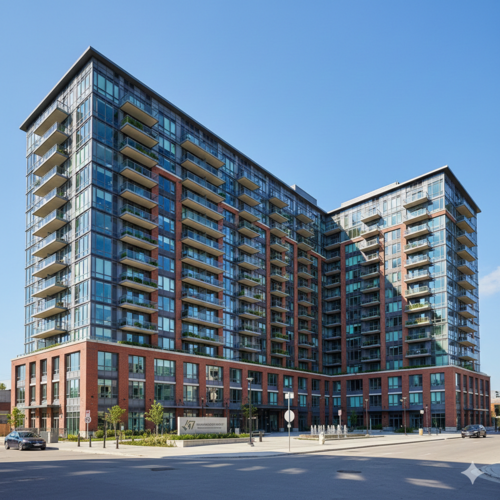

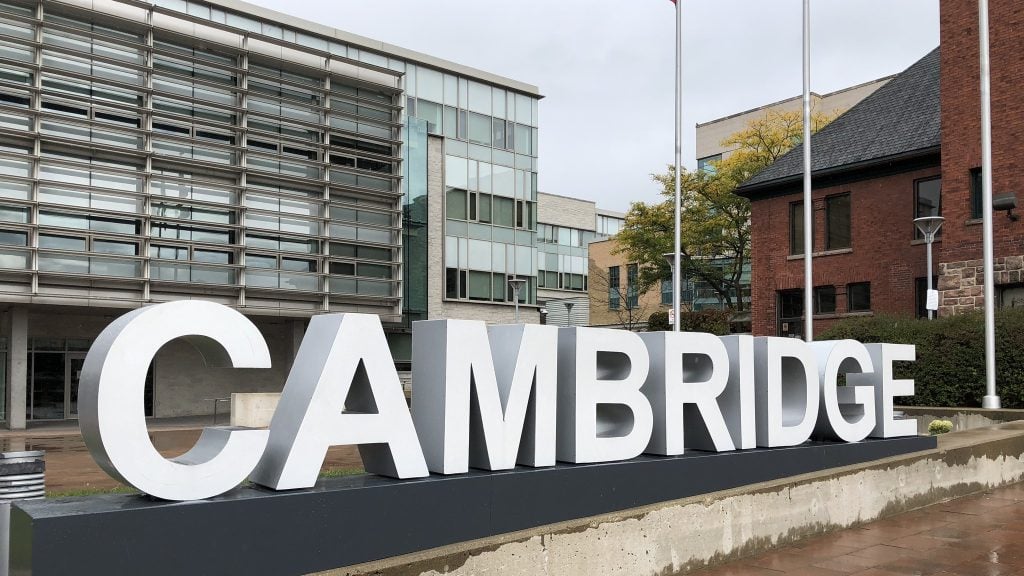
Cambridge is a city that tends to be underestimated by the broader development community. It lacks the profile of Kitchener or Waterloo, and for most of the past two decades that dynamic has kept land values more accessible than its regional peers. That spread is closing, and 868 King Street East sits at the centre of why.
Cambridge: Three Urban Centres, One Clear Direction
Cambridge was formed in 1973 from the amalgamation of three historic communities: Galt, the city's largest and most established urban core; Preston, a mature commercial corridor with growing transit connectivity to the Region; and Hespeler, the northernmost node with strong employment and residential character.
Development activity in Cambridge has historically concentrated in and around Galt. Preston has been the slower mover. That is changing, and the driver is a specific, capital-funded infrastructure investment already locked into the Regional plan.
The Site: What You Are Actually Buying
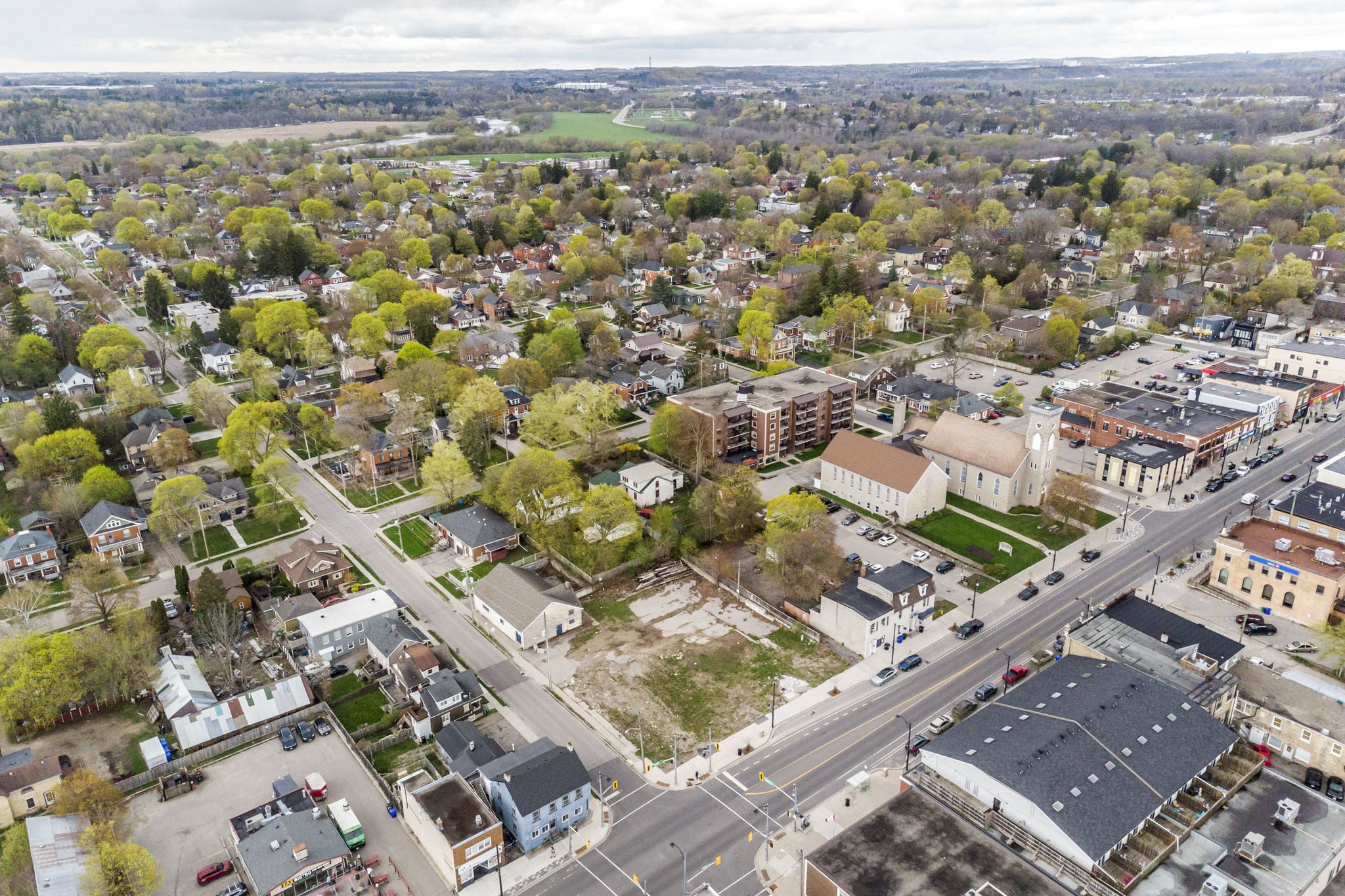
868 King Street East is a 20,193 sq. ft. (0.464-acre) corner parcel at King Street East and Potter Street in Preston. The property is vacant, cleared, and requires no demolition. The previous structure has been removed, environmental report has been completed (Phase II ESA by Chung and Vander Doelen Engineering, May 2021), and a Stage 2-4 Archaeological Assessment by WSP (November 2022) has been concluded.
These reports are available upon request to qualified Buyers.
Traffic: A High-Exposure Corner
Property record for 868 King Street East classifies this site's traffic pattern as Heavy, with predominant exposure to the west along King Street East. The property sits at a signalized corner, providing dual street frontage with 133.95 feet on King Street East and additional exposure on Lowther St S.
King Street East is a primary arterial in Preston serving both local and through-traffic. For any mixed-use or commercial-ground-floor program, this level of vehicular exposure and the corner geometry are meaningful advantages in establishing retail visibility and residential wayfinding.
Tenant & Buyer Demographics: A Growing, Economically Active Catchment
The following data is drawn from a demographics report generated for 868 King Street East (April 2026), using Environics Analytics data.
The broader 10-kilometre trade area is growing at 2.1% annually, is expected to reach nearly 300,000 people by 2033. That is the population base a mid-rise residential program draws its rental or ownership demand from. It is growing consistently.
The 5-kilometre daytime population of 77,066 reflects the employment density of this corridor. Workers who live and work in this catchment are a primary target for purpose-built rental product within walking or cycling distance of employment nodes.
Household formation within 2 kilometres of the site is growing at 2.0% annually, outpacing population growth, which is consistent with a trend toward smaller household sizes and increased demand for rental and compact ownership units. The average household income of $83,459 within 2 kilometres, and $103,508 within 5 kilometres, supports moderate-market rental rent levels and ownership pricing in the $500,000 to $700,000 range.
Education and Occupation
Within 5 kilometres, 40% of the working-age population holds a university degree or certificate, with a further 24% holding college or CEGEP credentials. The dominant employment categories include Sales and Service (7,746 workers within 5 km), Trades, Transportation and Equipment (5,392), and Business and Finance (4,817). This is a working and professional population with stable income profiles and a clear preference for rental and smaller-format ownership product.
Median Age
The median age within 2 kilometres is 41.2 years, and 38.4 within 10 kilometres. This is a mature market, not a student market, which supports higher average rents and more stable tenancy patterns than a post-secondary-dominated submarket would produce.
The ION LRT Extension: The Structural Argument for Preston
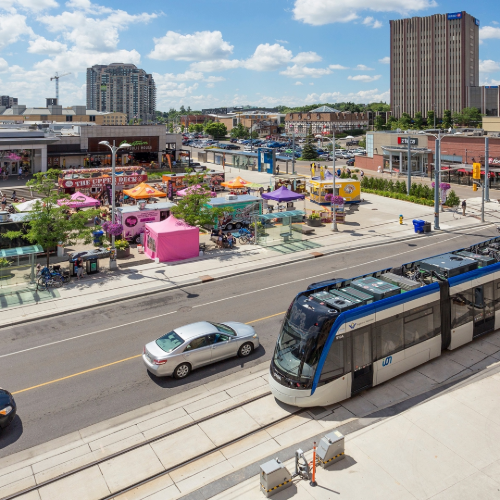
Preston Towne Centre is one of the four designated Major Transit Station Area (MTSA) nodes in the Region of Waterloo's approved Stage 2 ION Light Rail Transit extension, connecting the existing Kitchener-Waterloo LRT corridor south into Cambridge. Planning approvals for the extension are in place at the Regional level.
The pattern from the Stage 1 Kitchener-Waterloo corridor is instructive. Transit-adjacent land reprices ahead of infrastructure delivery, not after it. Developers who moved on MTSA-designated sites along the existing ION corridor before the trains were running captured land-to-value spreads that subsequent buyers could not access. Preston Towne Centre is at a comparable point in that cycle.
This is a concrete, policy-confirmed shift, not a speculative planning thesis. The MTSA designation is registered in the Regional Official Plan (October 2024 consolidation). The ION Stage 2 capital allocation is in the Regional budget. The question for a developer is not whether the transit premium will materialize, but who holds the land when it does.
Zoning: Mid-Rise Density Without a Zoning Amendment
The site carries C1RM2 zoning with a Mixed Use (Including Residential) Official Plan designation and the MTSA overlay applied through the Regional Official Plan.
The practical effect: medium- to high-density residential development, is permitted without requiring a zoning amendment. There is no OLT appeal exposure in the entitlement process. The planning risk that typically accounts for a significant portion of the development timeline and carrying cost on urban infill sites has already been absorbed by the existing zoning and official plan framework.
The MTSA overlay also provides access to potential density bonusing provisions, which create a negotiated path to additional gross floor area in exchange for community benefit contributions. This is a tool that may directly improves project economics on a site of this size.
The Rental Market: Consistent Demand in a Tightly Supplied Market
The Cambridge-Kitchener-Waterloo purpose-built rental market continues to demonstrate strong, consistent absorption. Purpose-built rental at a transit-adjacent MTSA location benefits from sustained demand from the working professional demographic identified in the trade area data above: working-age renters with stable incomes.
The broader 10-kilometre catchment's 2.1% annual population growth and 2.8% annual household growth through 2028 indicate that demand will continue to build ahead of new supply. Purpose-built rental on a cleared, MTSA-zoned corner site is positioned to capture that demand directly.
All information believed accurate as of May 2026. No representations or warranties are made. Prospective purchasers and their representatives must conduct independent due diligence.
About the Author: Terry Riddoch, Ontario Multi-Family and Commercial Real Estate Broker
 Terry Riddoch is a licensed Ontario real estate broker with Re/Max Real Estate Centre, based in Waterloo Region and specializing in multi-family and apartment building sales across Ontario. With 19 years of experience and over $90 million in closed transactions, he advises independent landlords, private investors, and national investment groups on buying, selling, and valuing apartment buildings, investments and development land across the Province of Ontario including Waterloo Region (Kitchener, Waterloo and Cambridge), Guelph, Brantford, Hamilton, London, Milton, Windsor, Kingston, Belleville, Brockville and Sudbury.
Clients know Terry for candid advice, data-driven analysis, and doing the work well ahead of the deal. He writes regularly on Ontario landlord rules, rent control, the Landlord and Tenant Board, and housing policy to help property owners make informed decisions.
Thinking about selling an apartment building, or looking for your next investment property? Call Terry at (519) 591-1725, email [email protected], or visit terryriddoch.ca for a confidential, no-obligation conversation about your property.
Check out this article next