
Photo: JFVoll, CC BY-SA 4.0, via Wikimedia Commons
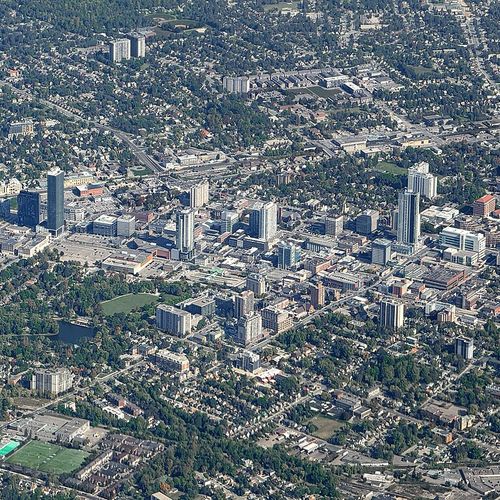
Waterloo, Ontario is the university and technology city of Waterloo Region. It is home to the University of Waterloo, Wilfrid Laurier University, a cluster of insurance companies and software firms such as OpenText [1]. Nearly four in ten households rent, more than half of working-age adults hold a university degree [2], and about half of the purpose-built rental stock has been built since 2000 [3].
The short answer: for an owner planning to hold for five years or more, yes, as long as you know how much of the building's rent depends on students. Waterloo has the highest household incomes and the lowest vacancy of the region's three cities. It is also the one whose population shrank in 2025 as international enrolment fell. The numbers behind that answer follow, and the full verdict is at the end of this post.
This primer is for anyone thinking about buying, selling or holding a multi-family building in Waterloo. It leaves cap rates and this month's pricing aside and looks at what drives a building's income over a hold of five years or more: who rents here, what pays their rent, what the rental stock looks like, and which local rules and projects could change the math.
Note: Sources are cited with a number in square brackets, like [1], and listed with hyperlinks at the bottom of this post.
At a glance
- Statistics Canada estimates Waterloo had 142,450 residents on July 1, 2025. That is up 34.4% in ten years but down 1.5% from 2024 [4]. The City counts 154,900 once students are included [5].
- 38.7% of households rent, up from 26.4% in 2011 [2][6].
- 54.5% of residents aged 25 to 64 hold a bachelor's degree or higher, against 36.8% across Ontario [2].
- Median household income was $94,000 in 2020, the highest of the region's three cities [2].
- International enrolment at the University of Waterloo is down 36% from its 2020/21 peak [7].
- Unemployment in the wider area was 7.7% in September 2026, against 6.9% for Ontario [8].
- Consumer insolvencies in the Kitchener area, which includes Waterloo, ran at 3.1 per 1,000 adults in 2025, below Ontario's 3.9 [9][10].
- CMHC counts 10,993 purpose-built rental units. Vacancy was 3.2% in October 2025, the lowest of the three cities, and the average two-bedroom rent was $1,901 [3][11].
- 975 rental units were under construction in August 2026, about 9% of the existing stock [3].
- Every rental unit outside an apartment building needs a City licence. Apartment buildings are exempt [12].
Where is Waterloo?
Waterloo is the northernmost of Waterloo Region's three cities and shares its southern boundary with Kitchener. In a straight line it is about 20 km from Cambridge, 25 km from Guelph and 95 km from downtown Toronto. The ION light rail line runs the length of the city, with eight Waterloo stations that include the University of Waterloo, Laurier-Waterloo Park and Waterloo Public Square, before it continues through Kitchener [13]. Waterloo has no GO train station. GO bus Route 25 serves both universities on its way to Mississauga [14].
Most residents work close to home. Of Waterloo residents with a regular workplace, 45% work inside the city, 43% work elsewhere in Waterloo Region and about 11% commute to a job outside the region [2].
Who rents in Waterloo?
At the 2021 Census, 18,205 Waterloo households rented, or 38.7% of the total. That is well above Ontario's 31.4% and close to Kitchener's 40.3% [2]. Ten years earlier the share was 26.4% [6]. Between 2016 and 2021 the city added about 5,600 renter households and about 1,050 owner households, so more than eight of every ten new households rented.
Waterloo is young. The median age is 36.0, against 41.6 for Ontario, and 27.6% of residents are aged 20 to 34, against 20.1% across the province. One household in four is a person living alone [2]. In 2021, 8.7% of residents were non-permanent residents, meaning people in Canada on study or work permits or claiming asylum. Kitchener's share was 3.7% and Cambridge's was 1.9% [2].
It is also highly educated and well paid. Among residents aged 25 to 64, 54.5% hold a bachelor's degree or higher, against 36.8% across Ontario and 24.7% in Cambridge [2]. People who worked full time all year earned a median of $74,500 in 2020, against $67,000 for Ontario. Median household income was $94,000, ahead of Cambridge at $93,000 and Kitchener at $87,000 [2].
One number needs care. At the 2021 Census, 40.9% of Waterloo tenant households spent 30% or more of their income on shelter, above Ontario's 38.4% [2]. Students are a likely reason. A student household can pay the rent from savings, loans or family support while reporting little income.
Is rental demand growing?
Over ten years, strongly. Statistics Canada estimates Waterloo's population at 142,450 on July 1, 2025, up from 106,012 in 2015. That is 34.4% growth, against 24.5% for Cambridge and 18.6% for Ontario. Waterloo outgrew the province in every year from 2016 to 2024 [4].
Then it stopped. The estimate fell by about 2,200 people, or 1.5%, in the year to July 2025. Kitchener and Cambridge both kept growing that year [4].
The cause is regional, and it lands hardest here. Across the wider area, non-permanent residents added more than 27,000 people in each of two years, then fell by 7,365 in the year to July 2025 [15]. My Kitchener primer, Is Kitchener a Good Place to Buy an Apartment Building?, covers that swing in more detail.
The long-range forecast still points up. The regional plan forecasts 185,000 permanent residents in Waterloo by 2051, up from 127,300 in 2021, and 114,900 jobs, up from 74,800. Students are not counted in that forecast [16].
How much does Waterloo depend on students?
More than its census numbers show. The census counts most post-secondary students at their parents' address [17], so many of them are missing from the figures above. The City and Region add them back. At the end of 2025 the City put its population at 154,900, including 32,200 students [5]. The Region counts 73,800 full-time students at campuses in the region: 38,400 at the University of Waterloo, 18,300 at Conestoga College and 17,100 at Wilfrid Laurier University [5].
International students drove both the boom and the pullback. The Region says they made up about 15% of local enrolment in 2016, 37% in 2023 and 17% now, after the federal cap on study permits [5]. At the University of Waterloo, international enrolment peaked at 9,410 full-time-equivalent students in 2020/21 and stood at 6,024 in 2025/26, a drop of 36% [7]. Total enrolment has held up better. It was 36,813 in 2025/26, about 2% below its level two years earlier, because domestic enrolment grew [7]. Laurier reported 23,587 students across all its campuses in fall 2025, about 5% of them international [18].
The City last counted student housing in 2023, using figures for the end of 2022. It found 39,865 beds serving students: 9,235 on campus, 22,285 in multi-residential buildings, 5,900 in licensed low-density rentals and 2,445 in traditional apartments. That was about 4,700 fewer beds than potential student tenants [19]. The count predates the cap on study permits, and I did not find a newer one.
For an owner, the question is which market a building is in. A conventional apartment building rented to working households and a building rented by the bedroom to students are different businesses with different risks. CMHC notes that the cap on study permits eased demand in areas with large student populations, and that this was clear in its Waterloo zone, where the vacancy rate rose [11]. The universities are employers as well as a source of tenants, and they are under pressure too. The University of Waterloo budgeted for a structural deficit of $33.7 million in 2026/27 before planned reductions, and had eliminated 165 staff and 49 faculty positions by October 2025 [20].
What pays the rent?
Three things: universities, insurance and technology. At the 2021 Census, 13.6% of Waterloo's resident labour force worked in professional, scientific and technical services and 13.3% in education, against 9.2% and 7.2% across Ontario. Finance and insurance employed 7.7%, against 5.4%. Manufacturing employed 10.3%, well below Kitchener's 16.1% and Cambridge's 18.6% [2].
The employer list matches. Statistics Canada counts 18 workplaces in the city with 500 or more employees. Five are classed as management of companies, a category that covers head offices. Three are in finance and insurance, three are in education and only one is a manufacturer [21]. The City names Sun Life, Manulife, Equitable Life of Canada and Economical Insurance among its insurers and says insurance companies together employ about 8,500 people locally. Its technology employers include OpenText, BlackBerry, Arctic Wolf, Faire and SAP [1].
The job market has softened. Jobs data is published for the combined Kitchener-Cambridge-Waterloo area, which had 389,100 people working in 2025, up from 289,800 in 2015 [22]. Unemployment there ran about a point below Ontario's through 2018. By 2025 the two were level at 7.7%. In September 2026 the local rate was 7.7% against 6.9% for the province, after peaking at 9.0% in April [22][8].
Trade is a smaller direct exposure here than in Kitchener or Cambridge, because fewer residents work in manufacturing. It still matters. Statistics Canada estimates that 13.7% of jobs in the Kitchener-Waterloo-Barrie economic region depend on American demand for exports, against 9.3% nationally [23], and many Waterloo residents work elsewhere in the region. I look at what the dispute means for local owners in Trade Wars, CUSMA and Your Apartment.
How financially healthy are Waterloo's tenants?
A rent roll is only as good as the tenants' ability to pay. No public source measures that for one city's renters, so I read four official indicators together.
Start with insolvencies. The Office of the Superintendent of Bankruptcy counted 3.1 consumer insolvencies (bankruptcies plus consumer proposals) per 1,000 adults in the Kitchener area, which includes Waterloo, in 2025. That was down from 3.4 in 2024 [9]. Ontario was at 3.9 and Canada at 4.1 [10]. Among the ten Ontario metropolitan areas covered in this series, only Guelph was lower at 3.0 [9]. A rate for Waterloo alone is not published, and the figure covers all adults, owners and renters alike, so read it as a gauge of household financial stress in the area, not as a tenant default rate.
The census adds a view of renters specifically. In 2021, 14.9% of Waterloo tenant households were in core housing need, against 24.9% across Ontario, and 6.7% lived in subsidized housing, against 13.7% [2]. Part of that gap is definitional. Statistics Canada does not count a non-family household led by a student aged 15 to 29 as being in core housing need, whatever its circumstances [24].
CMHC also surveys rent arrears, but it does not publish a figure for the Kitchener-Cambridge-Waterloo area. Across Ontario, 12.3% of purpose-built rental units had some rent in arrears in 2025, down from 14.3% in 2024, and the amount in arrears was 0.8% of the rent owed, down from 1.2% [25].
Put together, Waterloo's tenant base looks sturdier than the Ontario norm on debt and housing need, and no better than the province on jobs. These are city-level gauges for pricing risk. They say nothing about any one applicant, and a regulation under Ontario's Human Rights Code sets out what a landlord may ask for and consider when choosing a tenant [26].
What does the rental stock look like?
Waterloo's purpose-built rental stock is the newest of the three cities. CMHC counted 10,993 units in October 2025, against 24,116 in Kitchener and 6,819 in Cambridge [3][11]. About 51% are in buildings from 2000 or later. In Cambridge that share is 28%. Close to a quarter of Waterloo's apartment units are in buildings of 200 units or more [3].
A caution on what these figures cover. CMHC surveys privately built rental buildings with three or more units. Its published method does not say how buildings that rent by the bedroom to students are treated [27], so I cannot tell you how much of the student-oriented stock is in the numbers below.
Vacancy has not been above 3.2% in any October survey since 2015. It touched 1.2% in 2022 and reached 3.2% in 2025, level with Ontario and the lowest of the region's three cities [3][11]. For apartments alone it rose from 2.6% to 3.4%, a change CMHC rates as statistically significant [11]. The average two-bedroom rent went from $1,079 in 2015 to $1,901 in 2025, a rise of 76%, and rents on units surveyed in both 2024 and 2025 rose 3.0% [3].
Across the three cities, Waterloo has the lowest vacancy and the highest one-bedroom rent. Its two-bedroom rent of $1,901 is second to Cambridge's $1,918 [3][11]. My Cambridge primer, Is Cambridge a Good Place to Buy an Apartment Building?, has that city's numbers in full.
The split between old and new is sharp. A two-bedroom in a building from 1960 to 1979 averaged $1,666. In a building from 2000 or later it averaged $2,531. The newer buildings were also fuller, with 1.9% vacancy against 3.5% in buildings from 1960 to 1979 and 4.2% in those from 1980 to 1999 [3].
Building size tells a similar story. Apartment buildings of 200 units or more had 2.4% vacancy and an average two-bedroom rent of $2,518. Buildings of 20 to 49 units, a size many private investors buy, had 5.6% vacancy and the lowest two-bedroom rent at $1,603 [3]. CMHC does not say why. If you are looking at a mid-sized older building, ask for its vacancy history and who its tenants are.
Rent control works differently on the two halves of the stock. Ontario's guideline (2.1% for 2026 and 1.9% for 2027) does not cover units first occupied after November 15, 2018, and it does not apply when a unit turns over [28]. For the notice rules and exemptions in detail, see How Ontario Residential Rental Increases Work. CMHC does not publish how many units are exempt. As a rough guide, its count of Waterloo units in buildings from 2000 or later grew by 2,073 between October 2018 and October 2025, equal to about 19% of today's stock [3].
In the older stock, turnover is where rent resets, and the reset is smaller here than in Cambridge. Vacant two-bedroom apartments were asking an average of $2,033 in October 2025, against $1,913 for occupied ones [11]. CMHC estimates that 15.9% of Waterloo apartments turned over in the year to October 2025, up from 12.2%, though it marks the 2025 estimate "use with caution" [11].
New supply has been uneven. Rental starts ranged from zero to 949 a year between 2015 and 2025, with 506 in 2025 and only 93 in the first eight months of 2026 [3]. More is coming than the starts suggest. In August 2026, 975 rental units were under construction, about 9% of the existing stock, up from 556 in December 2025. Over the same months the number of condominium units under construction fell from 847 to 77 [3]. CMHC does not explain the shift. The numbers are consistent with projects planned as condominiums switching to rental.
In October 2026 Council approved 3,084 units at Northfield Drive West and Weber Street North, with a hold until water and sewer capacity is confirmed [29]. CMHC forecasts vacancy across the wider area at 4.5% in 2026 and 4.7% in 2027 and 2028 [30].
What are the local rules and costs?
Waterloo regulates rental housing more closely than Kitchener or Cambridge, and the rules turn on the type of building. Since July 1, 2026, every rental unit outside an apartment building needs a City licence, renewed each year. An apartment building is exempt if it has three or more storeys, five or more units and an interior common corridor. A triplex, a two-storey walk-up or a stacked townhouse does not qualify [12]. A standard licence costs $520 for a one-bedroom unit and up to $675 for five bedrooms, with renewals from $302 to $450 [12]. By mid-December the City had laid 282 charges against rental owners in 2025 [31]. I cover the licence classes, fees and deadlines in Waterloo's New Rental Licensing Bylaw: The 2026 Landlord's Guide.
A second by-law applies to every rental unit, apartment buildings included. Since July 1, 2026, a landlord who serves an N13 notice for renovations must apply for a renovation licence within seven days and pay $1,000 toward the tenant's moving costs. If the tenant chooses to return after the work, the landlord pays the difference between the tenant's rent and average market rent while the work is done, or provides a comparable unit [32]. A rental replacement by-law for buildings of six or more units has been drafted and consulted on but not passed [33]. Inclusionary zoning takes effect in the light rail station areas on July 1, 2027 [34].
Zoning leans toward building. Council approved four units and four storeys in low-rise neighbourhoods across the city in December 2024, and the City has removed minimum parking requirements in the light rail station areas [35].
Building still carries a large upfront cost. The City charges $14,816 in development charges on an apartment with three bedrooms or fewer, under a by-law that took effect on April 1, 2026. Add the Region's $23,570 and a new apartment carries about $38,400 before the rental discounts of 15% to 25%. Rental projects pay in six annual instalments from occupancy [36]. In June 2026 Council approved in principle a 30% cut to residential charges, tied to an application to a federal and provincial funding program. The City's rate page showed no reduced rates when I checked in October 2026 [37][36].
On the operating side, older buildings in the multi-residential tax class pay a rate of 2.647557%, about 1.85 times the residential rate of 1.432260%. Buildings in the new multi-residential class pay the residential rate [38].
What could change the picture?
Enrolment is the first thing to watch. The Region expects the cap on study permits to keep affecting its population for the next few years [5]. CMHC's next survey, expected in December 2026, will show whether vacancy kept rising after another drop in international enrolment. The first 2026 Census counts follow in February 2027 [39].
Water limits how fast new supply can arrive. The Region identified a water capacity shortfall in December 2025 in the service area that supplies Waterloo. The City adopted its own Water Supply Allocation Policy in July 2026. It ranks projects in five priority groups, with purpose-built rental in the third, and capacity can be withdrawn if a building permit does not follow within five months of site plan approval. The first allocations, in September 2026, went to 13 developments with about 1,250 units [40]. For owners of existing buildings, a limit on new construction is a form of protection.
The rules are still moving. Any decision on the draft rental replacement by-law falls to the council elected on October 26, 2026 [33]. Waterloo's provincial target is 16,000 new homes by 2031. It reached 129% of its annual target in 2024 and 88% in 2025 [41].
A new hospital is planned. The regional hospital network has chosen the David Johnston Research and Technology Park at the University of Waterloo as the site of a new hospital. The project is at the design stage and has no published cost or construction date [42].
The risks are a further fall in student numbers, new buildings competing with older ones for the same tenants, and a rule book that keeps growing.
The Waterloo scorecard
Here are the main numbers from this primer in one place, each with something to compare it to.
So, is Waterloo a good place to buy an apartment building?
For an owner planning to hold for five years or more, yes, with one condition: know how much of the building's income depends on students. Waterloo has the strongest tenant profile of the region's three cities and its tightest rental market. It also leans on one source of demand that is shrinking.
What works in its favour:
- The tenant profile. More than half of working-age adults hold a degree, full-time earnings run well above the Ontario median, and household income is the highest of the three cities [2].
- A job base built on campuses and offices. Universities, insurers and software firms anchor the economy, and manufacturing employs 10.3% of the labour force against 16.1% in Kitchener [2][1].
- Tenant finances. Consumer insolvencies in the wider area run below the Ontario rate, and a much smaller share of tenants is in core housing need than across the province [9][10][2].
- A fast-rising renter share. It went from 26.4% to 38.7% in ten years [2][6].
- The lowest vacancy of the three cities, at 3.2%, and 1.9% in buildings from 2000 or later [3][11].
- Apartment buildings are exempt from the City's rental licence [12].
What to watch:
- Students. International enrolment at the University of Waterloo is down 36% from its peak, and the city's population fell 1.5% in the year to July 2025 [7][4].
- Older and mid-sized buildings. Vacancy is highest in buildings from 1980 to 1999 and in buildings of 20 to 49 units [3].
- Competition from new buildings. Half the stock has been built since 2000, 975 rental units are under construction and another 3,084 units are approved [3][29].
- Regulation. Low-rise rentals need a licence, every N13 now needs a renovation licence, and a rental replacement by-law is in draft [12][32][33].
- A smaller rent reset on turnover. Vacant two-bedroom apartments ask about $120 more than occupied ones [11].
Who it suits. Buyers of conventional apartment buildings rented to working households, who price on the income in place and plan to hold. Buyers of low-rise buildings need to budget for licensing. Buyers of student-oriented buildings should underwrite enrolment, not last year's rent roll. This is a general view of the market, not advice on any particular property.
What it means for buyers, owners and sellers
For buyers. Start with the tenant list. Ask what share of the units is rented to students and how the leases are structured. Confirm whether the building meets the City's definition of an apartment building, because that decides whether every unit needs a licence, and a licence does not carry over to a new owner [12]. Check each unit's rent control status.
For current owners. Retention matters more with vacancy at a ten-year high. Serve the N1s. I work through what a skipped increase costs in cash flow and sale price in The N1 You Skipped Is Still Costing You. If you are planning work that needs vacant possession, the renovation licence now applies.
For sellers. A clean file sells. Have the rent roll, N1 records and each unit's rent control status ready, plus current licences for a low-rise building. Buyers will ask about student exposure, so have that answer ready too.
Frequently asked questions
Is Waterloo a good place to invest in apartment buildings?
For owners planning to hold for five years or more, the fundamentals are strong: 54.5% of working-age adults hold a university degree, household incomes sit above the Ontario median, the renter share rose from 26.4% to 38.7% in ten years, and the 3.2% vacancy rate is the lowest of Waterloo Region's three cities. The main risk is student demand. International enrolment at the University of Waterloo is down 36% from its peak, and the city's population estimate fell 1.5% in 2025.
What is the rental vacancy rate in Waterloo, Ontario?
Canada Mortgage and Housing Corporation measured the purpose-built rental vacancy rate in the City of Waterloo at 3.2% in October 2025, up from 2.5% in 2024 and 1.2% in 2022. Buildings from 2000 or later were at 1.9%, and apartment buildings of 20 to 49 units were at 5.6%. CMHC forecasts 4.5% for the wider Kitchener-Cambridge-Waterloo area in 2026.
What is the average rent for an apartment in Waterloo?
In CMHC's October 2025 survey the average two-bedroom rent in purpose-built rentals in the City of Waterloo was $1,901 a month, the average one-bedroom was $1,747, and the average across all unit sizes was $1,842. Two-bedroom units in buildings from 2000 or later averaged $2,531, against $1,666 in buildings from 1960 to 1979.
Do landlords need a rental licence in Waterloo?
It depends on the building. Since July 1, 2026, every rental unit outside an apartment building needs a City licence, renewed each year. Apartment buildings are exempt if they have three or more storeys, five or more units and an interior common corridor. A separate renovation licence applies to any rental unit where the landlord serves an N13 notice.
How much does Waterloo's rental market depend on students?
A great deal. The City counts 32,200 students on top of its permanent residents, and its last count found 39,865 beds serving students, 22,285 of them in multi-residential buildings off campus. Total enrolment at the University of Waterloo has slipped about 2% in two years, but international enrolment has fallen 22% over the same period and 36% from its 2020/21 peak.
Is Waterloo's population still growing?
Not in the latest year. Statistics Canada estimates the City of Waterloo had 142,450 residents on July 1, 2025, down 1.5% from 144,647 a year earlier, after ten-year growth of 34.4%. It was the only one of Waterloo Region's three cities to lose population that year. The regional plan forecasts 185,000 permanent residents by 2051, not counting students.
Are apartment buildings in Waterloo under rent control?
Yes, under Ontario's rules. The rent increase guideline is 2.1% for 2026 and 1.9% for 2027. Units first occupied for residential purposes after November 15, 2018 are exempt from the guideline, and the guideline does not apply when a unit turns over to a new tenant. About half of Waterloo's purpose-built rental units are in buildings from 2000 or later.
About the Author: Terry Riddoch, Ontario Multi-Family and Commercial Real Estate Broker
 Terry Riddoch is a licensed Ontario real estate broker with Re/Max Real Estate Centre, based in Waterloo Region and specializing in multi-family and apartment building sales across Ontario. With 19 years of experience and over $90 million in closed transactions, he advises independent landlords, private investors, and national investment groups on buying, selling, and valuing apartment buildings, investments and development land across the Province of Ontario including Waterloo Region (Kitchener, Waterloo and Cambridge), Guelph, Brantford, Hamilton, London, Milton, Windsor, Kingston, Belleville, Brockville and Sudbury.
Clients know Terry for candid advice, data-driven analysis, and doing the work well ahead of the deal. He writes regularly on Ontario landlord rules, rent control, the Landlord and Tenant Board, and housing policy to help property owners make informed decisions.
Thinking about selling an apartment building, or looking for your next investment property? Call Terry at (519) 591-1725, email [email protected], or visit terryriddoch.ca for a confidential, no-obligation conversation about your property.
Sources
- City of Waterloo, Key sectors and employers.
- Statistics Canada, Census Profile, 2021 Census of Population: Waterloo (City), Kitchener (City), Cambridge (City) and Ontario. Incomes are for 2020.
- Canada Mortgage and Housing Corporation, Housing Market Information Portal, City of Waterloo: Rental Market Survey (October 2015 to October 2025) and Starts and Completions Survey (to August 2026).
- Statistics Canada, Table 17-10-0155-01, Population estimates, July 1, by census subdivision, released January 14, 2026. The 2025 figure is preliminary.
- Region of Waterloo, 2025 Population and Household Estimates for Waterloo Region, June 2, 2026; City of Waterloo, Explore planning and land use data.
- Statistics Canada, Census Profile, 2016 Census, and National Household Survey Profile, 2011: Waterloo (City), households by tenure. The 2011 survey was voluntary.
- University of Waterloo, Institutional Analysis and Planning, Performance indicators: full-time-equivalent enrolment and international full-time-equivalent enrolment, 2016/17 to 2025/26.
- Statistics Canada, The Daily: Labour Force Survey, September 2026, released October 9, 2026, and Table 14-10-0459-01 (census metropolitan areas, three-month moving averages).
- Office of the Superintendent of Bankruptcy Canada, Annual Consumer Insolvency Rates by Census Metropolitan Area, updated July 28, 2026. Rates per 1,000 residents aged 18 and over.
- Office of the Superintendent of Bankruptcy Canada, Annual Consumer Insolvency Rates by Province and Economic Region, updated July 28, 2026 (Ontario and Canada).
- Canada Mortgage and Housing Corporation, 2025 Rental Market Report, December 11, 2025, with the Rental Market Survey Data Tables for Kitchener-Cambridge-Waterloo.
- City of Waterloo, Rental Housing Licensing Bylaw (By-law 2025-044, in force July 1, 2026) and Get a long-term rental licence (fees).
- Grand River Transit, ION light rail.
- GO Transit, Route 25 timetable (Table 25), effective September 5, 2026.
- Statistics Canada, Table 17-10-0149-01, Components of population change by census metropolitan area, released January 14, 2026.
- Region of Waterloo, Regional Official Plan Amendment No. 6, Table 1, adopted August 18, 2022 (population and employment forecasts to 2051); City of Waterloo, Official Plan.
- Statistics Canada, Dictionary, Census of Population, 2021: Usual place of residence.
- Wilfrid Laurier University, Registrar's Report, fall 2025, November 1, 2025.
- City of Waterloo, Student Accommodations Report 2023 (figures to the end of 2022).
- University of Waterloo, Waterloo's approved operating budget 2026/2027, April 17, 2026, and Progress on our 3-year budget plan, November 25, 2025.
- Statistics Canada, Table 33-10-1176-01, Canadian Business Counts, June 2026 (City of Waterloo).
- Statistics Canada, Table 14-10-0461-01, Labour force characteristics by census metropolitan area, annual, and Table 14-10-0464-01 (Ontario).
- Statistics Canada, United States tariffs and Canadian labour market trends, October 29, 2025.
- Statistics Canada, Dictionary, Census of Population, 2021: Core housing need.
- Canada Mortgage and Housing Corporation, Rental Market Survey Data Tables, Canada, Table 5.0, Rental Arrears: 2025 edition and 2024 edition.
- Government of Ontario, Ontario Regulation 290/98 under the Human Rights Code: Business Practices Permissible to Landlords in Selecting Prospective Tenants for Residential Accommodation.
- Canada Mortgage and Housing Corporation, Methodology for Rental Market Survey.
- Government of Ontario, Residential rent increases, updated June 23, 2026.
- City of Waterloo, Council summary, October 5, 2026 (170 to 200 Northfield Drive West and 570 to 655 Weber Street North).
- Canada Mortgage and Housing Corporation, Summer Update: 2026 Housing Market Outlook, July 22, 2026.
- City of Waterloo, City of Waterloo charges landlords for not complying with rental standards, December 15, 2025.
- City of Waterloo, Rental Housing Renovation Licence Bylaw (By-law 2026-012, in force July 1, 2026).
- City of Waterloo, Rental Replacement Bylaw (EngageWR project page).
- City of Waterloo, Council summary, February 9, 2026 (inclusionary zoning effective July 1, 2027).
- City of Waterloo, Council summary, December 9, 2024 (four units and four storeys) and General amendments to the Zoning Bylaw (parking).
- City of Waterloo, Development charges and Development Charges Bylaw (passed March 23, 2026, in effect April 1, 2026); Region of Waterloo, Regional Development Charges.
- City of Waterloo, Council summary, June 15, 2026 (Development Charge Reduction Program).
- City of Waterloo, Check property tax rates.
- Statistics Canada, 2026 Census of Population: key content release schedule.
- City of Waterloo, Water Supply Allocation Policy, adopted July 13, 2026, and Waterloo supports local housing and economy with confirmed water supply allocations, September 14, 2026; Region of Waterloo, Mannheim Service Area: information on development.
- Government of Ontario, Ontario's housing supply progress; City of Waterloo, Ontario rewards City of Waterloo through the Building Faster Fund, September 10, 2026.
- Waterloo Regional Health Network, Waterloo Region's new hospital.
Figures are current to October 9, 2026. "Wider area" means the Kitchener-Cambridge-Waterloo census metropolitan area. Percentages, growth rates, shares and straight-line distances not stated in a source are calculations by Terry Riddoch from the figures cited.
Check out this article next